Seven Strategies to Support State-level Health-Promoting Policies
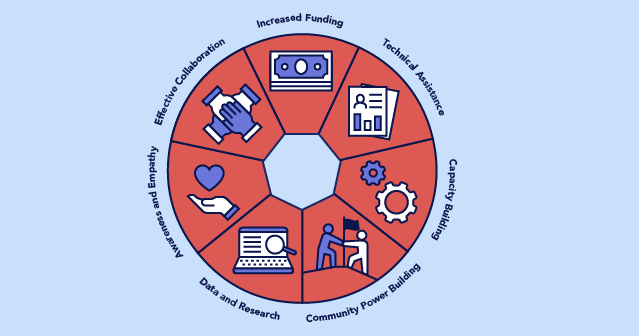
Reductions in federal and state funding, infrastructure, and workforce have reduced capacity for states to support communities’ health and wellbeing. With less federal support, states and localities will play an even more critical role in advancing health promoting policy.
However, state leaders and advocates face an increasingly complex policy environment to advance community health in the current landscape. As part of TFAH’s Promoting Health and Cost Control in States (PHACCS) initiative, we asked policy advocates and government staff from around the U.S. how national organizations and other non-federal partners can support efforts to advance policies and programs that can promote health and reduce healthcare spending.
The following summarizes those individuals’ responses, framed as opportunities for national-level partners to deepen their state engagement toward policy change.
Support Area 1: Increase funding for organizations, especially flexible use of funds.
Lack of flexible funding at federal, state, and local levels slows efforts to advance policy goals and address community needs. With federal funding in flux, support from philanthropic funders at community, state and national levels, as well as other national partners, can help address some of the funding gaps faced by community organizations.
National-level partners can:
- Provide seed funds to jumpstart implementation efforts.
- Educate grantees about how to maximize philanthropic funds for advocacy.
- Support flexible funding mechanisms for advocacy organizations to address their structural needs.
- Set realistic expectations for funding support through manageable timelines and goals.
- Allow for greater flexibility in how funds can be used so that organizations can address needs specific to their community.
Support Area 2: Provide targeted technical assistance to organizations with a specific need or problem.
Even as national-level partners face their own challenges, they can also help those at the local level meet the moment, especially as local resources and staff time are more constrained. Partners can invest in people and communities who can do the work effectively.
National-level partners can:
- Help organizations navigate the grant proposal process and identify relevant funding opportunities.
- Assist resource-strained organizations with developing funding proposals.
- Modify reporting requirements so that organizations can satisfy grant requirements and increase their chances for continued funding.
- Provide policy support and advice, especially in a fast-changing policy environment.
- Provide support for organizations to evaluate their work to demonstrate impact.
Support Area 3: Encourage capacity building that allows advocates to invest in people and communities who can do the work effectively.
Capacity building should inform community strategies to train and build skills for organizations to meet needs on their own and increase operational, programmatic, financial, or organizational capacity to advance their goals. National-level partners can:
- Ensure there is authentic power sharing between national and state/local advocacy groups or governments.
- Build governance expertise by helping state/local advocacy groups or governments understand their legal authorities and identify legal and policy tools to promote health.
- Help build coalitions and networking opportunities to enhance cross-sector collaboration and strengthen relationships.
- Provide resources that share best practices and evidence-based strategies to promote health.
- Offer advocacy skills, strategies, and tools to help state policy efforts gain bipartisan support.
Support Area 4: Invest in community power building that encourages deeper synergy between community, state/local government, and national partners.
Partnering with states to advance policy strategies can ensure there is a deeper throughline with community, state/local government, and national partners. National-level partners can:
- Develop tools to guide community power building by centering community needs.
- Incorporate community engagement efforts into funding.
- Help build political electoral power at state levels to harness and leverage community power to advance local, community-driven policy solutions.
- Help disengaged community members see systemic issues as solvable.
- Reframe wins and losses as steps for a long-term agenda to avoid burnout and create a culture of well-being.
Support Area 5: Ensure better access to and use of data and research, especially to inform stories for both decisionmakers and residents.
Even with greater mistrust in data, science, and evidence, national partners should continue supporting advocates in accessing readily available and easily interpretable data and research to build a case for evidence-based policy. National-level partners can:
- Improve the data and evidence base, considering how data is collected and shared back with communities.
- Ensure accountability for data sovereignty for Tribal nations and state relationships.
- Use local research and local examples of successful policy adoption and implementation to demonstrate the possibilities and benefits of pursuing a health-promoting policy.
- Provide support to ensure that quantitative data is paired with lived experience narratives to provide context for advocacy.
Support Area 6: Exercise empathy and awareness about the challenges faced by states and localities.
States and localities can feel isolated and misunderstood, especially as they face unique challenges amid evolving political and funding environments. To ensure states and localities feel heard and understood, national-level partners can:
- Recognize and acknowledge unique state and local challenges.
- Allow flexibility in reporting requirements and language, especially as some entities may be less able to pursue explicitly equity-focused efforts.
- Help partners build an advocacy case by sharing successful efforts and lessons learned by similar states or localities.
- Recognize the need to balance national and state and local expertise, knowing when to share leadership responsibilities in leading local efforts to advance policy.
Support Area 7: Maintain and nurture effective collaboration with partners to advance policy.
National-level organizations are uniquely positioned to help state entities identify partners to advance policy. Specifically, national groups can help build opportunities for brainstorming, collaboration and peer learning. To support collaboration, national-level partners can:
- Create spaces for state and local leaders to share and amplify their stories.
- Ensure authentic partnerships that offer equitable support for community partners.
- Use their convening power and knowledge of the field to identify a unifying goal and vision for the future.
- Provide resources for organizations and government partners to collaborate with others in similar states, political environments, and regions.