The Challenge of Vaccine Hesitancy Didn’t Start with COVID-19, and it Won’t End There

Will COVID-19 Vaccine Misinformation Lead to More Measles, Flu and Shingles?

Cecelia Thomas, JD

Just over one year has passed since the first availability of the COVID-19 vaccine. At this one-year mark 63 percent of U.S. adults are fully vaccinated. This ranks the United States as 60th in the world based on the percentage of fully vaccinated individuals. To say that these rates are troubling is an understatement. Even before the COVID-19 pandemic, the World Health Organization named vaccine hesitancy, the reluctance or refusal to vaccinate despite the availability of vaccines, as one of the top ten threats to global health. The consequences of this threat are tragically apparent with the deaths of mostly unvaccinated Americans. High levels of vaccine hesitancy have slowed the world’s ability to move past the pandemic and may be what’s allowed new variants of the virus to emerge.  Without addressing the root causes of vaccine hesitancy, more preventable infectious disease outbreaks will occur, and they will cost thousands of more lives in addition to further social and economic disruption.

Reasons for Vaccine Hesitancy
The problem of vaccine hesitancy did not start with COVID-19 and it likely won’t end there. In communities of color, vaccine hesitancy stems from long-standing health disparities and medical mistreatment . These deep and painful roots in this country’s history are exacerbated by the persistence of racial discrimination and bias in healthcare today and by practical barriers to vaccination such as health coverage limitations, inadequate transportation, and insufficient paid time off. While communities of color and low-income communities have had the most pervasive vaccine hesitancy historically, these groups are far from the only groups driving current vaccine hesitancy.

Efforts to rectify these past and present injustices should focus on cultural competence training for medical providers and community leaders on issues related to COVID-19 and routine vaccinations for children and adults. In addition, we need to improve vaccine accessibility and transparency. Other groups, other than populations that are systematically marginalized, such as white Evangelical Christians, have also expressed high rates of vaccine hesitancy before and throughout the pandemic. The politicization of public health that occurred during the last election intensified anti-vaccine sentiments, while social media and other platforms have allowed for the increased spread of misinformation.

Addressing Vaccine Hesitancy through Policy
Congress has recently passed legislation to fund fortified public health infrastructure to conduct and support widespread outreach, engagement, and vaccinations to communities across the nation. In addition, the COVID-19 Health Equity Task Force served as a forum for experts in the field to comprehensively address disparities in pandemic-related inequalities and develop solutions to issues such as vaccine accessibility and hesitancy. These are crucial steps at the federal level. States should follow suit with steps to bolster vaccination access and education.  Vaccine mandate bans are a step in the wrong direction and bad public policy.

Long-term Impacts of Vaccine Hesitancy
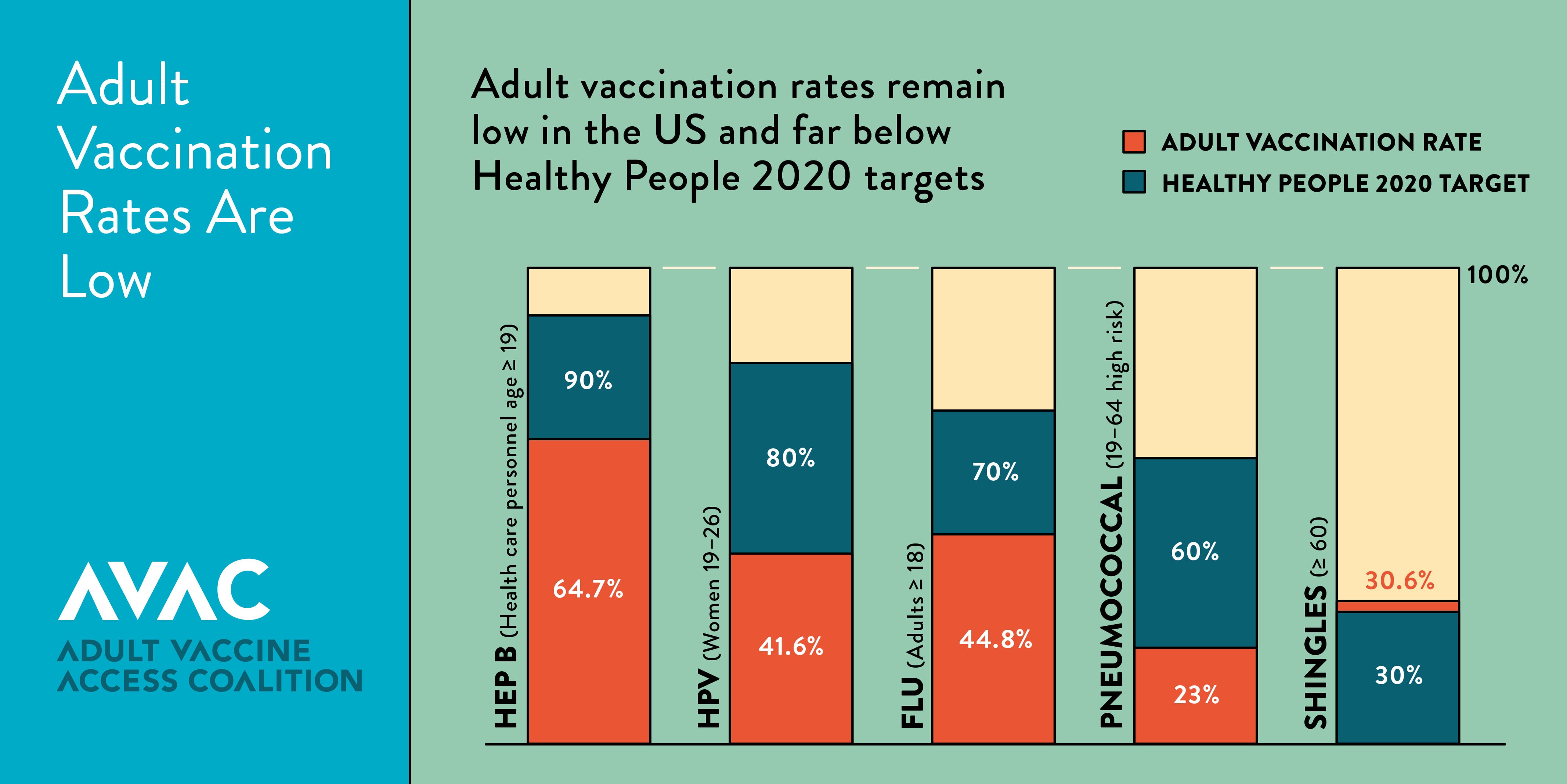
The U.S. also remains vulnerable to vaccine-preventable diseases such as flu, hepatitis B, pneumococcal, and shingles, due to under-vaccination. The threat of increased hesitance could further endanger people at higher risk for severe outcomes including older adults and people with underlying health conditions.  A year before the pandemic, the U.S. was in the midst of its worst measles outbreak in two decades and just narrowly preserved its measles elimination status.  The seasonal flu vaccine has also remained significantly underutilized in recent years. The lowest flu vaccination rate in recent years,  42% during the 2017-2018 flu season, contributed to 2017-2018 being the deadliest flu season in 40 years with 80,000 deaths. Despite this tragic reality check, the flu vaccination rate has yet to increase past 49% . If vaccination rates for diseases such as the seasonal flu do not improve, the combined burden of these infectious diseases will further strain the healthcare system and cause needless death and illness. There has also been a significant drop in routine vaccination rates across all ages due to the pandemic.  Adult vaccination rates are already far below Healthy People 2030 goals pre-pandemic and an estimated 26 million doses for adults and adolescents were missed in 2020.

Looking Forward
Congress, the Biden Administration and public health advocates must continue to work on immunization catch-up and support efforts to maintain high immunization coverage rates. These efforts are especially critical for the communities most impacted by COVID-19, such as communities of color and children. In October 2020, Trust for America’s Health co-hosted a national convening on building vaccine confidence and ensuring equitable access to the COVID-19 vaccine in communities of color, in partnership with the National Medical Association and UnidosUS. The policy recommendations of this report apply to other groups with growing rates of vaccine hesitancy, such as people who identify as politically conservative. Recommendations from the resulting policy brief also extend beyond the COVID-19 vaccine:

  • Expanding federal funding to support and strengthen national, state, local, Tribal and territorial work on equitable and effective vaccination planning, communications, distribution and administration, including funding to support vaccine distribution at the local level and by community-based organizations;
  • Collaborating with trusted community messengers/leaders for vaccine administration and education;
  • Creating culturally and linguistically appropriate vaccine education;
  • Ensuring zero out-of-pocket costs for individuals receiving recommended vaccines; and
  • Collecting complete disaggregated racial and ethnic data on adverse experiences in healthcare as well as health outcomes.

While these recommendations are most immediately applicable to the COVID-19 pandemic, they will also be important to increasing vaccine trust in the future.  These methods have already begun to work, vaccine hesitancy and racial gaps in vaccinations are beginning to slowly decrease. We must build on this momentum and prioritize increasing vaccine confidence across the U.S. to ensure that the nation is better prepared for future public health crises.

Cecelia Thomas, JD, is a Senior Government Relations Manager at Trust for America’s Health

 

TFAH Applauds Introduction of the Protecting the Health of America’s Older Adults Act

(Washington, DC – December 16) – Trust for America’s Health, a non-partisan, nonprofit public health policy, research and advocacy organization, applauds the introduction of the bipartisan Protecting the Health of America’s Older Adults Act by Representatives Lois Frankel (CA-44), Gus Bilirakis (FL-12) and Debbie Dingell (MI-12). The bill would enable state and local public health departments to better meet the needs of older adults via innovative new strategies.

If enacted, the bill would create a Healthy Aging grant program at CDC to provide grants to health departments to help states and local communities coordinate multi-sector efforts to promote the health of older adults and develop aging expertise. The grant program would allow state and local health departments to apply an aging lens to all of their work, including efforts to reduce healthcare costs and improve health equity. The COVID-19 pandemic has demonstrated the importance of public health’s role in the aging sector, and this new program will help ensure that health departments have the resources they need to make a meaningful impact for seniors.

The President and CEO of Trust for America’s Health, Dr. J. Nadine Gracia, congratulates Representatives Frankel, Bilirakis, and Dingell on the introduction of the bill, stating:

“The last year underscored how important it is for public health to be at the table when it comes to promoting the health of older adults. Health departments have been critical to addressing the needs of older adults during the pandemic; their active engagement in many other issues faced by the aging population, including transportation and housing access, chronic disease, and mental health, will promote better aging outcomes and benefit our entire society. This new grant program would be a step in the right direction to ensure that state and local health departments have the resources to do exactly that.”

In addition to TFAH, original endorsing organizations include:

  • Alliance for Aging Research
  • American Association on Health and Disability
  • American Lung Association
  • American Muslim Health Professionals
  • American Public Health Association
  • American Psychological Association
  • Association of Schools and Programs of Public Health
  • Association of State Public Health Nutritionists
  • Association of State and Territorial Health Officials
  • Authority Health
  • Catholic Health Association of the United States
  • Center for Advocacy for the Rights and Interests of the Elderly (CARIE)
  • Ceres Community Project
  • Christian Council of Delmarva
  • Coalition of National Health Education Organizations
  • Common Threads
  • Elder Options
  • Equality California
  • FLIPANY
  • Florida Public Health Association
  • The Gerontological Society of America
  • Hartsfield Health Systems Consulting, LLC
  • Lakeshore Foundation
  • Long Beach Gray Panthers
  • Maine Council on Aging
  • Maine Public Health Association
  • Mel Leaman Free Clinic
  • MindWise Innovations
  • National Association of Nutrition and Aging Services Programs
  • National Network of Public Health Institutes
  • National Recreation and Park Association
  • National Senior Games Association
  • Peggy Lillis Foundation
  • The Praxis Project
  • Prevent Blindness
  • Silver State Equality-Nevada
  • Society for Public Health Education
  • Society for Women’s Health Research
  • Tennessee Justice Center
  • Urban Health Partnerships
  • Valley AIDS Council
  • WARM, Inc.
  • Washington State Public Health Association
  • We All Rise

TFAH has prepared a fact sheet on the legislation.


Trust for America’s Health and Well Being Trust Applaud the Surgeon General’s Advisory on Youth Mental Health

The challenges to our children’s mental health were many before COVID-19 and made worse by the pandemic – immediate action is needed

(December 7, 2021) – Trust for America’s Health and Well Being Trust strongly applaud U.S. Surgeon General Dr. Vivek Murthy’s Advisory on Youth Mental Health released today.

“We applaud the Surgeon General for not only drawing more attention to the issue of youth mental health, but reminding us that this problem, significant before COVID-19, has been negatively impacted during, and could only get worse after the pandemic without robust action,” said Benjamin F. Miller, PsyD, President of Well Being Trust.  “By proactively addressing mental health, including bringing care to where people are, we are more likely to meet the moment in a way that can help countless young people and their families.”

The Surgeon General’s advisory calls for “a swift and coordinated response” to the nation’s youth mental health crisis and demonstrates the need for all sectors of society to be part of the solution with recommendations for what individuals, families, community organizations, technology companies and government can do to improve and protect young people’s mental health.

“One of the strengths of this advisory is that it recognizes that in order to support young people’s mental health we need to address the social and economic conditions in their lives with multisector initiatives, said J. Nadine Gracia, M.D., MSCE, President and CEO of Trust for America’s Health. “Where a child lives, where they go to school, their family’s access to employment and safe housing all impact their mental health.”

TFAH and WBT’s Pain in the Nation series has tracked the nation’s deaths of despair since 2017 including the escalating youth mental health crisis. Its report Addressing a Crisis: Cross-Sector Strategies to Prevent Adolescent Substance Use and Suicide. makes recommendations for cross sector action.


# # #


Trust for America’s Health is a nonprofit, nonpartisan organization that promotes optimal health for every person and community and makes the prevention of illness and injury a national priority. Twitter: @HealthyAmerica1

Well Being Trust is a national foundation dedicated to advancing the mental, social, and spiritual health of the nation. Created to include participation from organizations across sectors and perspectives, Well Being Trust is committed to innovating and addressing the most critical mental health challenges facing America, and to transforming individual and community well-being. www.wellbeingtrust.org. Twitter: @WellBeingTrust


Trust for America’s Health Applauds COVID-19 Health Equity Task Force Report

Addressing health inequities is critical to protecting everyone’s health and being prepared for future health public emergencies

(Washington, DC – November 10, 2021) – Trust for America’s Health (TFAH) applauds the report of the COVID-19 Health Equity Task Force, including its recommendations to President Biden for mitigating the health inequities caused or exacerbated by the COVID-19 pandemic and for preventing such inequities in the future. We furthermore commend the Biden Administration  for responding to the report’s call to action with new investments in initiatives to improve community and public health in traditionally under-resourced communities, including communities of color and among underserved populations.

In January of 2021, the Biden Administration created the Task Force, a multisector group of individuals with expertise and lived experience relevant to groups suffering disproportionate rates of illness and death from COVID-19, experts in fields such as public health, healthcare, behavioral health, and community-based services, as well as government officials. The Task Force represents diverse perspectives on how to address COVID-19 related health and social inequities and strengthen the nation’s public health response.

“The COVID-19 pandemic has exposed and exacerbated longstanding systemic inequities in our nation,” said J. Nadine Gracia, MD, MSCE, President and CEO of Trust for America’s Health.  “The COVID-19 Health Equity Task Force has laid out a road map for reducing inequities during this pandemic and before the next public health emergency.  As the report acknowledges, we must engage in a multisector effort to address the upstream factors that contribute to underlying health inequities in order to promote optimal health and build resilience in all communities. TFAH looks forward to working with the administration on our shared goals.”

The Task Force’s report echoes many of TFAH’s policy recommendations. The following are policy priorities shared by the Task Force report and TFAH:

  • Fund the public health workforce and emergency response. The federal government should increase and sustain funding for equity-centered pandemic and public health emergency activities and infrastructure at the federal, state, local, Tribal, and territorial levels. This should include building a workforce dedicated to public health emergency preparedness, response, recovery, and disaster-related behavioral health services and supporting communities with the greatest healthcare inequities.
  • Support equity-centered data collection. The federal government should fund an equity-centered approach to data collection, including ensuring sufficient funding to collect data for groups that are experiencing disproportionate impact during the pandemic and to understand the specific needs of currently underserved populations.
  • Fund data modernization for health settings. The federal government should provide funding for healthcare and public health to update data systems centered on equity and to ensure interoperability and automatic electronic lab reporting of a robust set of disaggregated, standardized socioeconomic and demographic data elements.
  • Strengthen multi-sector collaboration. The federal government should strengthen collaboration with a diverse array of community-based organizations and public health providers by providing robust and sustained funding to build capacity, provide technical assistance and establish partnerships with communities of color and other underserved populations.
  • Prioritize vaccine, testing, treatment, and personal protective equipment (PPE) access for underserved communities. Federal, state, local, Tribal, and territorial governments should prioritize vaccine distribution, testing, treatment, and PPE access to communities of color and other underserved populations, including those who face mobility, geographic, or other barriers to access.
  • Address the social determinants of health. The federal government should lead efforts to advance the social determinants of health including nutrition safety net programs for individuals and families who are food insecure and for those that have limited access to healthy food options.
  • Increase access to behavioral healthcare. Federal, state, local, Tribal, and territorial governments should increase investment in and access to comprehensive, equity-centered behavioral health services, including a focus on prevention.
  • Lead and coordinate implementation of the COVID-19 Health Equity Task Force’s recommendations from a permanent health equity infrastructure in the White House.

TFAH reports on emergency preparedness, public health funding, leveraging policy to improve Americans’ health and create health equity, and a legislative blueprint to transform the nation’s public health system, include additional recommendations that support the Task Force’s health equity goals.

Annual Deaths Due to Alcohol, Drugs or Suicide Exceeded 156,000 According to the Most Recent Data

Preliminary data shows COVID-19 crisis created higher rates of mental distress, substance use, and drug overdose; 2019 alcohol deaths were higher for every adult age group

(Washington, DC and Oakland, Ca) – May 18, 2021 – Newly released data show that 156,242 Americans died due to alcohol, drugs or suicide in 2019, a record number of such deaths in a single year.  Furthermore, the COVID-19 pandemic increased stress and related substance use for many Americans.

During 2019, alcohol and drug-induced deaths increased, while suicide rates were slightly lower. Over the last decade, 2009 – 2019, the number of alcohol and drug related and suicide deaths increased by 52 percent.  These data are part of a report releasing today, Pain in the Nation: Alcohol, Drug and Suicide Deaths, the latest in a series of reports tracking the nation’s deaths of despair crisis produced by Trust for America’s Health and Well Being Trust.

Americans dying due to drug-induced causes was five percent higher in 2019 than the previous year, for a total of 74,511 deaths. The data are also beginning to show changes in the most affected population groups.  For many years, the death rate for drug overdoses among whites was substantially higher than other racial groups, data are now showing dramatic increases in drug related deaths for certain populations of color. For the year, drug-induced deaths were up by 15 percent among Latinos and Blacks, 11 percent for American Indians and 10 percent for people of Asian descent. Among whites’ drug-induced deaths rose by 2 percent for the year.

For the first time since 2005, 2019 deaths rates from drugs for Black people was higher than that of whites.

Synthetic opioids, such as fentanyl, (up 16%), cocaine (up 8%) and other psychostimulants (e.g., methamphetamine and ecstasy) (up 28%) continue to drive drug-induced deaths higher. Natural/semisynthetic opioids (e.g., Prescription opioids) and heroin overdoses declined for the year.

In 2019, 39,043 Americans died from alcohol-related causes, up 4 percent over 2018.  It was the tenth year in a row that the alcohol death rate increased.  Alcohol deaths were highest among American Indians (31.9 deaths per 100,000 people), adults over 55 (28.3 deaths per 100,000 people) and males (15.2 deaths per 100,000 people). All groups, except children, had a higher rate of alcohol deaths in 2019 compared with 2018 and early 2020 data show that rates of consumption are continuing to increase.

One bright spot in the data is that for the year (2019), the age-adjusted suicide rate declined from 14.2 to 13.9 deaths per 100,000 deaths, a 2 percent decrease. Americans who died by suicide in 2019 totaled 47,511. This decline in suicide deaths was the first since 2005 and is statistically significant. Preliminary 2020 data show a further small decrease in suicides despite the COVID crisis.

States with the highest age-adjusted death rates from alcohol, drugs and suicide combined in 2019 were New Mexico (88 deaths per 100,000 people) and West Virginia (85.1 deaths per 100,000 people).

“These data underscore, yet again, the massive problem we have had on our hands in this country,” said Benjamin Miller, PsyD, Chief Strategy Officer, Well Being Trust. “The trends are clear we are going in the wrong direction. If we are serious about addressing mental health and addiction, we must invest in strategies that are comprehensive and integrated. Incremental tinkering will not change the course or direction sufficiently enough – it’s time for bold leadership to demand more.”

The Impact of the COVID-19 Pandemic

The COVID-19 pandemic impacted Americans in almost inconceivable ways including illness, the loss of loved ones, job loss, financial stress, food insecurity, social isolation, and learning loss and the interruption of school-based services for millions of children. These stressors are impacting rates of alcohol and drug use and drug overdose deaths as more people turn to substances to help them cope.

From March 2019 to March 2020, the number of calls to the Substance Abuse and Mental Health Services Administration Disaster Distress Helpline increased by 891 percent.  The U.S. Household Pulse Survey found that the number of adults reporting symptoms of anxiety or depression from April 2020 through March 2021 was triple the number who reported such symptoms in 2019. A June 2020 CDC study found that 13 percent of adults “started or increased substance use to cope with pandemic-related stress or emotions.”

“The drug, alcohol and suicide crisis has been growing for a decade and growing in uneven ways. The COVID crisis has increased stress on all Americans and has worsened the differential impact of health inequities on communities of color. While all Americans need support coping with the pandemic, people who are currently struggling with addiction or a mental health issue need urgent attention,” said John Auerbach, President and CEO Trust for America’s Health.

The report includes policy solutions and recommendations including:

  • Expand programs that support families and communities and reduce traumatic experiences, particularly in childhood.
  • Expand access to substance use prevention programs and mental health and resiliency programs in schools.
  • Tailor prevention and intervention programs for communities of color.
  • Strengthen crisis intervention programs and supports.
  • Increase access to mental health and substance use healthcare through full enforcement of the Mental Health Parity and Addiction Equity Act.
  • Reduce availability of illicit opioids and psychostimulants.
  • Limit access to lethal means of suicide.
  • Expand efforts to combat stigma about mental health issues.
  • Improve mental health data accuracy, completeness and timeliness.
  • Expand the mental health and substance use treatment workforce; promote diversity and culturally informed practices within the workforce.
  • Build community capacity for early identification and intervention with individuals who need mental health care.

# # #

 Trust for America’s Health is a nonprofit, nonpartisan organization that promotes optimal health for every person and community and makes the prevention of illness and injury a national priority.

Well Being Trust is a national foundation dedicated to advancing the mental, social, and spiritual health of the nation. Created to include participation from organizations across sectors and perspectives, Well Being Trust is committed to innovating and addressing the most critical mental health challenges facing America, and to transforming individual and community well-being. www.wellbeingtrust.org. Twitter: @WellBeingTrust


Congressional Briefing: Ready or Not 2021: Protecting the Public’s Health from Diseases, Disasters, and Bioterrorism

Ready or Not 2021: Protecting the Public’s Health from Diseases, Disasters and Bioterrorism. A panel of subject matter experts will discuss the nation’s readiness for public health emergencies, examine the findings of the report, and discuss key recommendations for policymakers.

Resources:

Nuevo informe encuentra lagunas en la preparación de los estados para emergencias de salud pública

La COVID-19 muestra daño crítico de subinversión en infraestructura de salud pública

(Washington, DC) — 10 de marzo de 2021 – La pandemia de COVID-19 ha demostrado claramente que la inversión insuficiente en la preparación para responder a emergencias de salud pública puede costar cientos de miles de vidas y causar estragos en la economía. Un nuevo informe publicado hoy por Trust for America’s Health (TFAH) midió el desempeño de los estados en 10 indicadores clave de preparación para emergencias y encontró espacio para mejorar en todas las jurisdicciones.

El informe Ready or Not 2021: Protecting the Public’s Health from Diseases, Disasters and Bioterrorism midió la preparación de los estados para emergencias de salud de cualquier tipo (no solo la crisis del COVID-19).  Este informe colocó a 20 estados y al Distrito de Columbia en una categoría de alto nivel de preparación, 15 estados en un nivel de preparación medio y 15 estados en un nivel de preparación bajo.

Durante casi dos décadas, TFAH ha examinado la preparación para emergencias de salud pública de la nación en este informe anual. Durante ese tiempo, todos los estados han mejorado su preparación para emergencias, pero todos continúan teniendo espacio para un fortalecimiento adicional de sus programas de respuesta de salud pública.


Rendimiento estatal, por nivel de puntuación, 2020

Performance Tier States Number of States
High Tier CO, CT, DC, DE, GA, ID, KS, MA, MD, ME, MS, NC, NE, NM, OK, RI, UT, VA, VT, WA, WI 20 states and DC
Middle Tier AL, CA, FL, IA, IL, KY, LA, MI, MN, MT, ND, NJ, OR, TN, TX 15 states
Low Tier AK, AR, AZ, HI, IN, MO, NH, NV, NY, OH, PA, SC, SD, WV, WY 15 states

“La importancia de este informe es que brinda a los estados datos procesables para adoptar políticas que salven vidas. La crisis de COVID-19 muestra que tenemos mucho más trabajo por hacer para proteger a los estadounidenses de las amenazas a la salud, particularmente en las formas en que el racismo estructural crea y exacerba los riesgos para la salud dentro de las comunidades de color ”, dijo John Auerbach, presidente y director ejecutivo de Trust for Salud de Estados Unidos. “Los estados deben tomar medidas enérgicas para apuntalar su preparación para todo tipo de emergencias de salud pública”.

Si bien los hallazgos del informe no son una medida de la respuesta COVID-19 de ningún estado, demuestran que si bien la preparación de los estados es importante, las emergencias de salud nacionales en la escala de una pandemia requieren un liderazgo y una coordinación federales fuertes, e inversiones a largo plazo en salud pública. infraestructura y mano de obra. Los estados por sí solos, incluso aquellos que ocupan un lugar destacado en este informe, no están lo suficientemente equipados para responder a una pandemia sin ayuda federal, dicen los autores del informe.

El informe encontró:

La mayoría de los estados han hecho preparativos para expandir la atención médica y las capacidades de salud pública en una emergencia, a menudo a través de la colaboración. Treinta y cuatro estados participaron en el Nurse Licensure Compact, en comparación con 26 en 2017. El pacto permite a las enfermeras registradas y las enfermeras prácticas o vocacionales con licencia ejercer en múltiples jurisdicciones con una sola licencia. En caso de emergencia, esto permite a los funcionarios de salud aumentar rápidamente sus niveles de personal. Además, los hospitales de la mayoría de los estados tienen un alto grado de participación en coaliciones de salud. En promedio, el 89 por ciento de los hospitales estaban en una coalición y 17 estados y el Distrito de Columbia tenían participación universal, lo que significa que todos los hospitales de la jurisdicción eran parte de una coalición. Dichas coaliciones unen a los hospitales y otras instalaciones de atención médica con la gestión de emergencias y los funcionarios de salud pública para planificar y responder a los incidentes. Finalmente, todos los estados y el Distrito de Columbia tenían laboratorios de salud pública que tenían planes para una gran afluencia de necesidades de pruebas. Esta capacidad de aumentar la capacidad de prueba de laboratorio durante la crisis de COVID-19 fue extremadamente crítica.

La mayoría de los estados están acreditados en las áreas de salud pública, manejo de emergencias o ambos. A diciembre de 2020, la Junta de Acreditación de Salud Pública (PHAB) o el Programa de Acreditación de Gestión de Emergencias (EMAP) acreditaron 42 estados y el Distrito de Columbia; 29 estados y el Distrito de Columbia fueron acreditados por ambos grupos, un aumento neto de uno desde noviembre de 2019. Ambos programas ayudan a garantizar que los sistemas necesarios de preparación y respuesta ante emergencias estén en su lugar y con personal calificado.

Las tasas de vacunación contra la influenza estacional, aunque aún son demasiado bajas, han aumentado significativamente. La tasa de vacunación contra la influenza estacional entre los estadounidenses de 6 meses o más aumentó del 42 por ciento durante la temporada 2017-2018 al 52 por ciento durante la temporada 2018-2019, pero aún está por debajo de la tasa de vacunación objetivo del 70 por ciento establecida por Healthy People 2030.

En 2019, solo el 55 por ciento de los residentes estatales empleados, en promedio, usaron tiempo libre remunerado, el mismo porcentaje que en 2018. Aquellos sin licencia remunerada tienen más probabilidades de trabajar cuando están enfermos y corren el riesgo de propagar la infección. Esto se volvió particularmente relevante durante la pandemia de COVID-19, ya que el aislamiento y la cuarentena son herramientas importantes para controlar el brote.

La mayoría de los residentes que obtuvieron el agua de su hogar a través de un sistema de agua comunitario tenían acceso a agua potable. En promedio, solo el 5 por ciento de los residentes del estado utilizó un sistema de agua comunitario en 2019 que no cumplía con todos los estándares de salud aplicables.

El informe incluye recomendaciones de acciones por parte de los legisladores federales y estatales para mejorar la preparación para emergencias de salud pública de la nación en siete áreas prioritarias:

  • Proporcionar financiación suficiente y estable para la seguridad de la salud pública nacional y mundial.
  • Fortalecer las políticas y los sistemas para prevenir y responder a brotes y pandemias.
  • Construir comunidades resilientes y promover la equidad en salud en general y en la preparación.
  • Asegurar liderazgo, coordinación y fuerza laboral efectivos en salud pública.
  • Acelerar el desarrollo y la distribución, incluida la distribución de última milla, de contramedidas médicas.
  • Fortalecer la capacidad del sistema de salud para responder y recuperarse durante y de emergencias de salud.
  • Prepárese para las amenazas ambientales y el clima extremo.

El informe de la serie Ready or Not está financiado por la Fundación Robert Wood Johnson con el apoyo adicional de The California Endowment, W.K. Fundación Kellogg y Fundación Kresge.

###

Trust for America’s Health es una organización no partidista sin fines de lucro que promueve la salud óptima para cada persona y comunidad y hace de la prevención de enfermedades y lesiones una prioridad nacional. Twitter: @HealthyAmerica1