Issue Category: Public Health Preparedness
TFAH’s President and CEO Dr. Gracia Discusses the Significance of Dr. Martin Luther King Jr. Day & National Day of Racial Healing
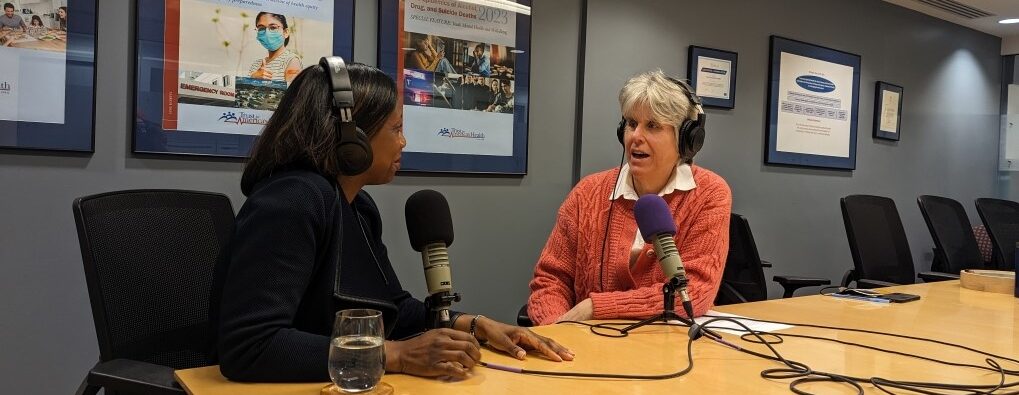
(Washington, DC – January 15, 2024) – This week TFAH’s President and CEO, Dr. J. Nadine Gracia and Director of Strategic Communications and Policy Research Rhea Farberman discussed the significance of two important observances, Dr. Martin Luther King Jr. Day and the National Day of Racial Healing. The conversation focused on the intersections between Dr. King’s mission to advance social justice and TFAH’s work to promote optimal health. Also discussed were the ways in which structural racism creates barriers to good health for many people of color and the policy actions needed to dismantle those barriers.
“What we know, especially in thinking about this in terms of Dr. Martin Luther King, Jr. Day and the National Day of Racial Healing, is that for too many people of color and communities of color there has been, over many decades, a disadvantage in terms of access to health promoting resources.”
“We have to act with a sense of urgency because the health, well-being and prosperity of our nation depends on it. That’s the call that I believe Dr. King would challenge us to continue, to strive for and not relent. That’s his legacy to us, to ensure that everyone us the opportunity to reach their full potential for health.”
Dr. J. Nadine Gracia
President and CEO
Trust for America’s Health
“Listen to the full conversation”
Navigating Climate-Related Threats to the Public’s Health
The Urgency of Emergency Preparedness in Light of Extreme Weather Events
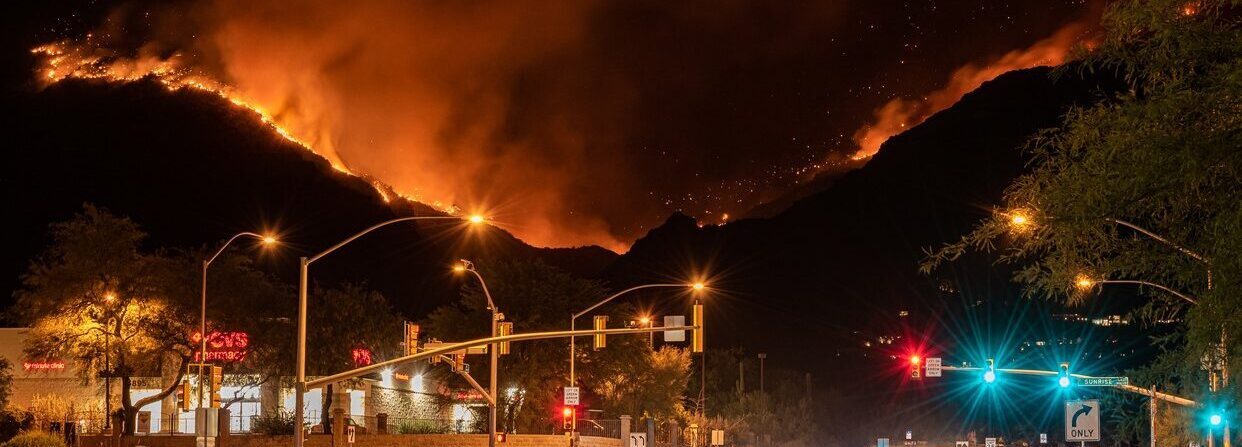
(August 29, 2023) In the first eight months of 2023, the United States confronted numerous climate challenges, indicating a pivotal moment for the nation and the planet. Hawaii faced the country’s deadliest wildfires in over a century, claiming more than 100 lives and leaving a staggering cost in their wake. In California, storms tested the state’s resilience through floods and mudslides, while in Phoenix, weeks of intense heat threatened its most vulnerable residents. In Vermont, rivers surged past their banks, while haze from Canadian wildfires degraded air quality in more than a dozen states. And all this as the year’s hurricane season is just getting underway.
These events demonstrate the escalating public health threats driven by climate change and the need for public health officials to play a role in addressing them. As global temperatures rise, we are seeing an uptick in heat-related illnesses and even fatalities, especially among individuals who are most at risk. Rising sea levels and intensified storms lead to flooding, which can contaminate drinking water and spread waterborne diseases. Meanwhile, wildfires, exacerbated by droughts and higher temperatures, compromise air quality, leading to a spike in respiratory problems, from asthma to chronic bronchitis. Furthermore, shifting climate patterns are expanding the range of many infectious disease vectors, like mosquitoes, exposing new populations to illnesses like malaria or dengue. The ripple effects of climate change touch nearly every aspect of public health, demanding policymakers’ attention and action.
Below is a partial round-up of the climate-related challenges that the country has already faced in 2023.
Wildfires in Hawaii. The U.S. grappled with its deadliest wildfires in over a century when fires that began as isolated brush incidents on the islands of Hawaii and Maui were intensified by the effects of Hurricane Dora and quickly escalated. Many public officials and residents were caught off guard by the size and rapid spread of the flames, leading to the tragic loss of more than 100 lives. Residents and officials now confront daunting reconstruction needs. Despite Hawaii’s reputation for lush greenery, its defenses have been compromised by significant reductions in rainfall. Diminished La Niña patterns, which traditionally bring cooler and wetter conditions to the region, have shifted, leading to warmer and drier trends. Furthermore, the proliferation of flammable invasive grasses, supplanting native vegetation, increases the fire risks.
Smoky skies. Canada, grappling with one of its harshest wildfire seasons, has seen tens of millions of acres of its landscape consumed by flames. The repercussions have been felt beyond its borders, with smoke significantly degrading air quality in several U.S. regions, including New England, the Southeast, and the Midwest. These conditions have led the Environmental Protection Agency to issue air quality alerts affecting millions of Americans. This sharp rise in fires is largely linked to the effects of global warming, which brings about drought and intense heat, rendering forests more vulnerable to blazes.
California storms. In early 2023, intense rains hit California. While they replenished reservoirs and snowpacks, they also caused flooding, mudslides, sinkholes, and tree damage that impacted infrastructure. A severe winter storm in late February trapped residents and led to the deployment of the California National Guard. Shortly after, another storm in the Sierra Nevada caused two fatalities and power disruptions. March saw the arrival of two bomb cyclones that brought tornadoes, heavy rain, and snow. These extreme weather events, exacerbated by climate change, underscore California’s oscillation between droughts and powerful storms. Such climatic shifts create atmospheric rivers that deliver heavy precipitation.
Notably, Southern California effectively weathered Tropical Storm Hilary’s record-setting rainfall in August, in part due to proactive measures like school closures and swift emergency response to road flooding and fallen trees. Despite the storm’s potential severity, no deaths were reported in major areas like Los Angeles and San Diego, highlighting the importance of preparedness.
Groundwater shortages in Arizona. Arizona officials sounded the alarm in June on groundwater shortages, signaling a potential halt to the rapid housing development in the Phoenix area, which is among the fastest-growing regions in the U.S. Although existing building permits will remain unaffected, the announcement underscores the urgent need for alternative water sources and conservation measures in future projects. Governor Katie Hobbs reassured that Arizona is not immediately running out of water, but shortages could have significant implications for the region’s future. Prolonged drought, combined with increasing water demand, have depleted the Colorado River and intensified water scarcity, posing a challenge for the region’s long-term sustainability.
Vermont flooding. In July, Vermont experienced severe flash and river flooding, leading to extensive damage to communities, roads, bridges, and causing significant property losses. This event broke several records, with Montpelier’s airport receiving the highest single-day rainfall since 1948. The destruction was comparable to the damage from Tropical Storm Irene in 2011. In terms of impact, the destruction from the 2011 and 2023 events was only surpassed by the Great Flood of November 1927, which took place before modern flood control measures were implemented in the state.
Hot water off the coast of Florida. A buoy off Florida’s coast this summer measured a sea surface temperature of 101.1 degrees Fahrenheit, potentially setting a new world record and far exceeding the typical range of 73F to 88F. This extreme heat, part of a concerning trend of warming waters in Florida, poses grave risks to marine life, ocean ecosystems, and human livelihoods. Increasing temperatures, intensified by phenomena like El Niño, could also boost the strength of tropical storms and hurricanes.
Extreme heat in Phoenix. Phoenix endured an unprecedented heatwave in July, with temperatures exceeding 110°F for 31 straight days, surpassing a 1974 record. This coincided with a global trend marking July the warmest month ever registered. Hospitals reported an uptick in heat-related cases, ranging from heat cramps to lethal heat strokes. The city’s medical examiner confirmed 25 heat-related deaths and is investigating many more. Critical infrastructure, such as air conditioners in shelters and medical buses, malfunctioned due to the extreme temperatures. With shelters at full capacity and public housing waitlists stretching for months, many unhoused residents were left without a haven from the oppressive temperatures.
President Biden announced initiatives in July to support communities suffering from extreme weather. To combat the rising heat, the primary weather-related cause of death in the U.S., he directed the Department of Labor (DOL) to issue its first-ever Hazard Alert concerning heat, with the intent to reinforce worker protections against heat-related dangers under federal law. This alert will educate employers on their responsibilities and help ensure that workers know their rights. The DOL has committed to intensifying its enforcement against heat-safety violations, focusing especially on high-risk sectors like construction and agriculture. Meanwhile, the National Oceanic and Atmospheric Administration is allocating up to $7 million to enhance weather forecasting in collaboration with educational institutions, aiming to boost preparedness for extreme weather events. Additionally, the Department of the Interior is in the process of investing $152 million to bolster water storage and climate resilience in California, Colorado, and Washington, addressing the challenges of prolonged drought and ensuring access to clean drinking water.
These efforts build on past actions by the Biden-Harris Administration, such as channeling billions of dollars via the Department of Housing and Urban Development for energy-efficient building upgrades and the establishment of cooling centers. Additionally, in collaboration with Congress, it earmarked over $50 billion from the Infrastructure Investment and Jobs Act to bolster climate resilience throughout the nation.
As Trust for America’s Health (TFAH) has previously highlighted, preparing for weather-related events is a critical element of public health emergency preparedness. Collaboration between public health officials and partners—such as federal, state, local, tribal, and territorial agencies, emergency response teams, community-based organizations, and hospitals—is fundamental. Working together, they can pave the way for better preparation and response strategies, utilizing data to predict and lessen potential health impacts. Proactive measures are crucial in safeguarding communities from these escalating threats. For example, the nation needs significant investment in climate-resilient infrastructure — from storm-resistant housing to updated water management systems. To protect people from extreme heat, communities must prioritize public education on heat risks, establish cooling centers, and adapt urban infrastructure to reduce heat retention. It’s crucial to acknowledge that socioeconomic and health inequities have historically worsened the impact of extreme heat on communities of color, making targeted interventions in these communities even more essential. Strengthening early warning systems and ensuring equitable access to hydration and emergency healthcare resources are vital steps. It’s also imperative to bolster our health systems’ readiness to respond to the increasing burden of climate-related illnesses. This includes enhancing disease surveillance and training healthcare professionals to recognize and treat emerging health threats, especially in communities that face disproportionate risks.
In line with a comprehensive public health approach, the Building Resilience Against Climate Effects (BRACE) framework from the Centers for Disease Control and Prevention (CDC) offers a vital tool. This strategic framework empowers officials to develop and implement health adaptation plans tailored to their specific climate change challenges. By guiding health departments through a five-step process — from forecasting climate impacts and assessing vulnerabilities to developing and implementing a comprehensive adaptation plan — the BRACE framework ensures a data-driven response that accounts for local nuances. Recognizing the disparate effects of climate change on various populations, this approach emphasizes not just broad community safeguards but also targeted interventions to protect those most at risk. To more adequately support these crucial initiatives, TFAH recommends funding the CDC’s Climate and Health Program at a level of $110 million for Fiscal Year 2024. This program collaborates with state, local, tribal, and territorial health agencies to address climate change impacts, primarily utilizing the BRACE framework. Additionally, it offers resources, funding, and support through various initiatives to enhance community preparedness and communication regarding climate-related health risks. As communities continue to witness the tangible effects of a changing climate, leaning into systematic and strategic frameworks like BRACE becomes paramount. The synthesis of proactive planning, community-specific interventions, and overarching public health strategies helps bring about a resilient and equitable response.
Acting to protect health and well-being by improving our systems’ readiness and enhancing protective measures—commonly termed climate adaptation—is a critical public health priority. Climate mitigation refers to efforts to reduce or prevent greenhouse gas emissions or to remove them from the atmosphere, aiming to curb future global warming. Both the Intergovernmental Panel on Climate Change, a scientific body under the auspices of the United Nations that assesses climate change information, and the United States Global Change Research Program, which coordinates U.S. research on global environmental changes and evaluates climate change impacts, emphasize that mitigation and adaptation are complementary strategies crucial for reducing the human impacts of climate change.
August is National Immunization Awareness Month
August is National Immunization Awareness Month. This annual observance is designed to remind everyone that staying up to date on vaccinations is an important way to protect not only their health but the health of everyone around them.
Vaccines are a public health success story. Today, we are fortunate to have a broad spectrum of safe and effective vaccines, which if received on schedule, protect patients of all ages against vaccine-preventable diseases. Current vaccines protect against childhood disease including chicken pox, measles, and whooping cough, while protecting adults from the flu, Tdap, and shingles. Vaccines have also eradicated or nearly eradicated life-threatening diseases, such as smallpox and polio.
Children as young as 1-2 months old should be vaccinated against childhood illnesses and school-age children may need vaccine updates before they can return to school this fall. Ensuring that every child sees their doctor for a well-child visit and to receive any needed vaccine or vaccine updates is one of the best ways a parent can protect their child’s health and that of the community. Because the immunity created by a vaccine can lessen overtime, it’s important that children receive their vaccines on the recommended schedule. Adults may also need vaccine updates or to receive recently approved vaccines such as the RSV vaccine for adults 60 years of age and older.
During the COVID-19 pandemic, routine childhood vaccination levels among school-age children in the U.S. decreased, likely due to missed well-child medical visits. Globally, a report by UNICEF and the World Health Organization found that childhood vaccination coverage worldwide increased with about 4 million more children receiving full immunizations in 2022 compared to 2021, but were still below pre-pandemic levels.
Vaccines meet strict safety and effectiveness measures
In the U.S., safety measures are strict and prioritized to ensure that vaccines are safe for patients. Before any vaccine is approved for use, it is tested for safety and effectiveness through clinical trials and then must be approved by the Food and Drug Administration (FDA) and recommended by the Center for Disease Control and Prevention’s (CDC) Advisory Committee on Immunization Practices. While some people experience mild side effects after receiving a vaccine, such as swelling at the shot area, mild fevers and chills, serious reactions are extremely rare. Overall, the safety of all vaccines is closely monitored to ensure their continued safe use. If patients have questions about a vaccine including any potential side effects, they should speak to their healthcare provider.
Statement for the record by TFAH President & CEO J. Nadine Gracia for House Energy & Commerce Health Subcommittee Hearing on Legislative Solutions to Bolster Preparedness and Response for All Hazards and Public Health Security Threats
TFAH President & CEO Dr. J. Nadine Gracia speaks to JHU’s Public Health on Call podcast about the steps necessary to improve state and national emergency response readiness.

J. Nadine Gracia, M.D., MSCE, President and CEO of the Trust for America’s Health (TFAH), joined the Johns Hopkins Bloomberg School of Public Health podcast, Public Health on Call to discuss the nation’s and states’ readiness to respond to public health emergencies and the findings of TFAH’s Ready or Not 2023: Protecting the Public’s Health from Diseases, Disasters, and Bioterrorism report.
“As we transition out of the emergency phase of the pandemic, now is not the time to turn our focus away from public health,” Dr. Gracia told podcast host Dr. Joshua Sharfstein. In addition, Dr. Gracia highlights the importance of sustained public health funding, as well as a focus on health equity. Listen to the full interview.
TFAH hosted the Congressional Briefing and National Webinar, Ready or Not 2023 on May 3, where a panel of experts discussed national emergency preparedness and areas for additional focus.
TFAH President & CEO Dr. J. Nadine Gracia discusses the 2023 Ready or Not report
Dr. J. Nadine Gracia, President and CEO of the Trust for America’s Health (TFAH), discussed the results of TFAH’s Ready or Not 2023: Protecting the Public’s Health from Diseases, Disasters, and Bioterrorism report with the Public Health Review Morning Edition.
Dr. Gracia highlights the report’s findings that “the public health system has been chronically underfunded” and notes that “Congress and lawmakers should provide increased and sustained funding in support of the public health infrastructure.” Listen to the full interview.
On May 3 at 2PM ET, TFAH will host the Congressional Briefing and National Webinar, Ready or Not 2023. Register today to learn more about the nation’s emergency preparedness.
Ready or Not 2023: Protecting the Public’s Health from Diseases, Disasters, and Bioterrorism
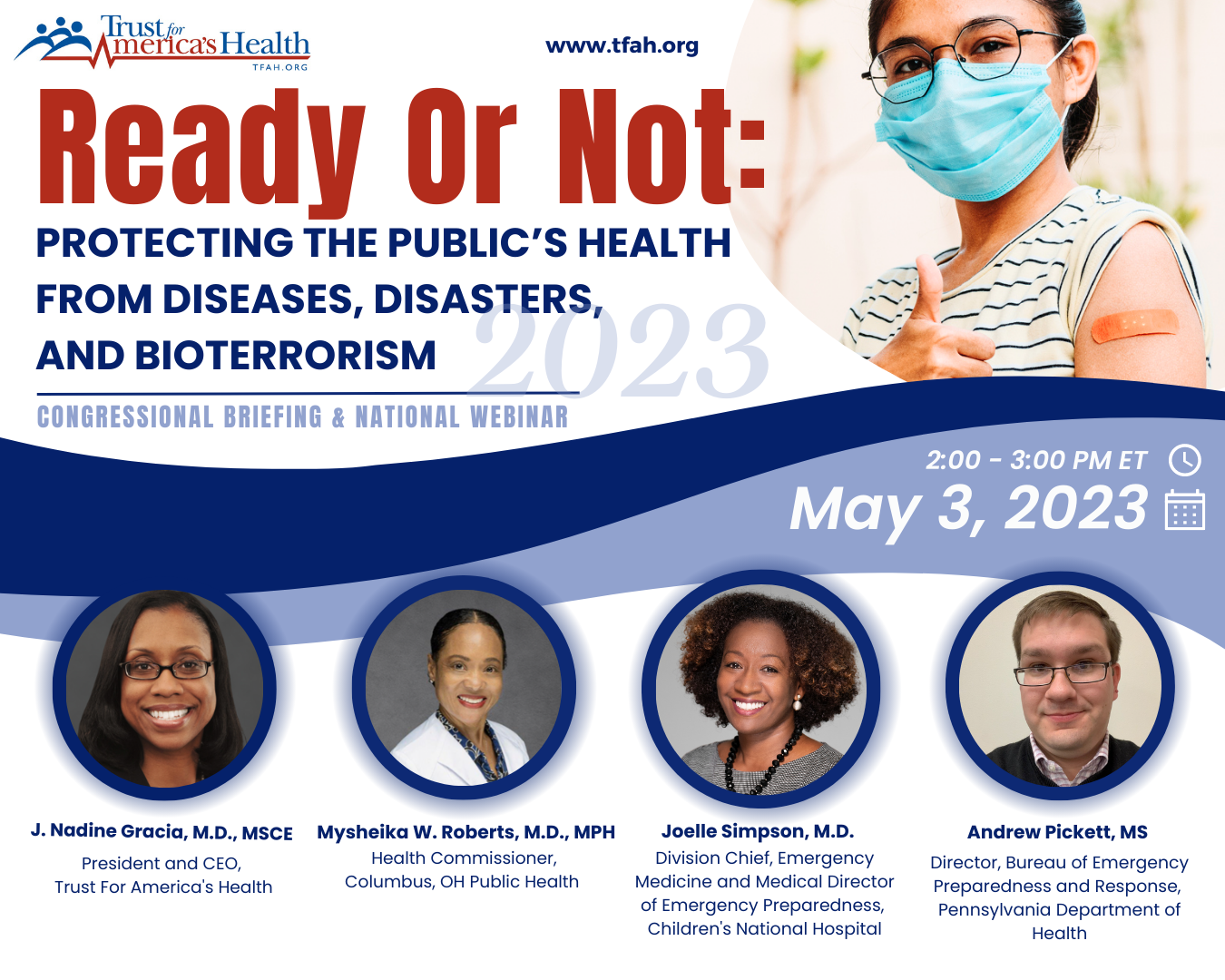
This briefing explores the findings from TFAH’s recent report, Ready or Not 2023: Protecting the Public’s Health from Diseases, Disasters, and Bioterrorism.
The past year alone saw the U.S. surpassing 1 million deaths due to COVID-19, decreasing rates of routine vaccinations, and increasing prevalence of health misinformation. In addition, last year the U.S. experienced 10 or more billion-dollar weather-related disasters for the eighth consecutive year. The webinar will review TFAH’s 2023 Ready or Not report which measures states’ degree of preparedness to respond to a wide spectrum of health emergencies and to provide ongoing public health services.
Subject matter experts discussed the nation’s readiness for public health emergencies, examine the findings of the report, and discuss key recommendations for policymakers.
Resources:
Trust for America’s Health
- Ready or Not 2023: Protecting the Public’s Health from Diseases, Disasters, and Bioterrorism
- Ready or Not 2023 – State-by-State Fact Sheets
Children’s National Hospital
Unseen Guardians: Measles Outbreak Highlights Public Health’s Crucial Role and Evolving Challenges

Local health officials and CDC work together to stamp out Ohio measles outbreak
In 1912, the United States formally recognized measles—a highly contagious viral infection causing fever, cough, runny nose, red eyes, and a characteristic rash in milder cases, while leading to pneumonia, encephalitis, and death in more severe instances—as a nationally notifiable disease. For centuries, this ubiquitous childhood ailment afflicted millions. In the first decade of reporting, an annual average of 6,000 measles-related fatalities were recorded in the U.S.
The introduction of the first measles vaccine in 1963, with its near-perfect efficacy, marked a turning point. The vaccine was later combined with those for mumps and rubella (MMR) in 1971, and varicella (MMRV) in 2005, providing children protection against several diseases in a single shot. Bolstered by this potent new preventive tool, the Centers for Disease Control and Prevention (CDC) set a goal in 1978 to eliminate measles from the country. This objective was realized in 2000, thanks to robust vaccination campaigns, the introduction of a second dose in 1989 to increase efficacy, and rigorous disease surveillance systems.
In the new millennium, measles appeared a relic of the past, but the specter of outbreaks returned—first in the 2014-15 Disneyland episode, and then in the largest outbreak in decades in 2019. Declining vaccination rates, fueled by skepticism and misinformation, left vulnerable communities exposed. The 2019 outbreak primarily affected unvaccinated children in communities with low vaccination rates across 31 states, such as ultra-Orthodox Jewish communities in New York and vaccine hesitant regions in Washington. Travelers imported the virus, sparking infections among the unvaccinated.
One such measles outbreak erupted in Ohio in 2022. Between November 2022 and February 2023, when the outbreak was declared over, 85 cases were reported, primarily affecting children under five, with 36 hospitalizations. Among the 85 cases, 80 were unvaccinated, including 25 infants too young to receive their first dose.
To quell the outbreak, a team of epidemiologists from the CDC worked in concert with Columbus Public Health to track cases, identify and notify exposed residents, and understand the spread of the virus. Dr. Mysheika Roberts, Columbus’s health commissioner, led the outbreak response, raising awareness of the disease through public information and education, and promoting and easing access to vaccination.
In addition to the on-the-ground work of state and local health departments, the CDC plays a vital, often behind-the-scenes role in supporting those departments and safeguarding public health. It provides robust disease surveillance systems, expert guidance, technical assistance, and financial support, enabling locally targeted interventions and infrastructure improvements.
Though the latest outbreak was successfully contained, the Ohio measles episode may portend further challenges. Vaccine hesitancy, a complex and deeply ingrained phenomenon, threatens to erode hard-won public health gains and could precipitate resurgent outbreaks. The issue has multifaceted roots including mistrust in science and institutions, and misinformation amplified on digital platforms. In communities of color, vaccine hesitancy is compounded by longstanding health disparities and medical mistreatment.
The COVID-19 pandemic exacerbated the problem, with routine vaccination rates falling due to school closures and disrupted well-child doctor visits. A recent Kaiser Family Foundation poll revealed that, amid the politicization of COVID-19 vaccines and school mandates, over a third of parents with children under 18 believe they should have the choice to not vaccinate their children against measles, mumps, and rubella, even at the risk of others’ health. This represents a 52% increase compared to 2019. During the 2021-22 school year, kindergarten vaccination coverage fell to roughly 93%, leaving about 250,000 kindergartners potentially unprotected against measles.
Tackling vaccine hesitancy and strengthening our public health systems requires a multifaceted national approach. Federal, state, and local governments should invest in accessible, science-based education campaigns that dispel myths and foster trust. Working with local partners, public health agencies are developing tailored, culturally sensitive vaccine education and access programs that bridge gaps in understanding and acceptance.
The Ohio measles outbreak serves as a stark reminder that the fight against vaccine-preventable diseases remains ongoing, the indispensable role of the public health workforce, and the critical need for a robust public health system. Increased, sustained, and flexible public health funding is key to having such a system. As is growing a diverse workforce to ensure that those shaping policy and delivering services reflect the communities they serve. By taking these steps, among others, we can reduce vaccine hesitancy, create a more robust public health system, and foster an environment of trust in science. Doing so can protect the hard-won progress made against measles and other diseases, safeguard the health and well-being of generations to come, and pave the way for a more equitable future.