At One Year Mark Data Show 988 Suicide and Crisis Lifeline Has Improved Crisis Care Access and Response, and that Sustained and Increased Funding is Needed

This month marks the one-year anniversary of the 988 Suicide and Crisis Lifeline, which replaced the previous National Suicide Prevention Lifeline with a single three-digit number for mental health, substance misuse, and crisis services. With oversight and funding from the Substance Abuse and Mental Health Services Administration (SAMHSA) and assistance from partners like Crisis Text Line and The Trevor Project, 988 consists of independently operated and funded call and text/chat centers across the country. When individuals in crisis contact 988, trained crisis counselors at these centers listen, provide support, and share resources if necessary. Access to 988 can play a critical role in improving depressed, suicidal, or overwhelming feelings—in fact, SAMHSA estimates that 98% of individuals contacting 988 receive the crisis support they need in the moment. SAMHSA has also identified the current 988 system as a first step toward evolving crisis care to include mobile crisis units, which provide in-person responses, and stabilization centers, which provide a safe place to stay for individuals in crisis.

Even its current form, however, 988 represents a momentous advancement in the effort to connect more Americans with crisis services. In May 2023, for example, 988 answered 45% more calls, 52% more chats, and 938% texts compared to the previous lifeline in May 2022. In total, 988 answered nearly 160,000 more contacts in May 2023 compared to May 2022, and the average time to answer these contacts decreased from 140 seconds to 35 seconds. 988 has also launched specialized services for the LGBTQ+ population, and SAMHSA just announced the addition Spanish language text and chat services. Other specialized services will likely follow for hearing impaired individuals and American Indian/Alaska Native people.


In 2022, Congress supplemented the establishment of 988 with several pieces of legislation containing significant investments and policies to advance behavioral health. The Bipartisan Safer Communities Act (BSCA), passed in June 2022, for example, provided onetime support for 988 and increased support for the National Child Traumatic Stress Network. The BSCA also provided funding for Project AWARE at SAMHSA, which empowers education agencies through training for school personnel, increases awareness and detection of mental health issues, and connects youth and families to needed services. In addition, Congress directed the Centers for Medicare and Medicaid Services to assist schools with expanding school-based health services through Medicaid and funded initiatives at the U.S. Department of Education to hire and retain mental health professionals providing these services.


In the Consolidated Appropriations Act (CAA), enacted in December 2022, Congress built on these accomplishments by reauthorizing the Garrett Lee Smith Suicide Prevention Program, which funds mental health programs for college-age students, as well as several programs to improve the behavioral health workforce. The CAA also bolstered crisis-intervention programs by directing guidance and funding to providers and improving payment for their services.


The U.S. Department of Health and Human Services (HHS) also acted throughout 2022 to expand access to community-based mental health services. In partnership with the Department of Education, for example, HHS has worked to facilitate the use of Medicaid and Children’s Health Insurance Program funds to support school-based behavioral health services. SAMHSA also launched the Mental Health Crisis Response Partnership Pilot Program to improve access to mobile crisis services in high-need areas.

988 is part of a series of investments to address Americans’ mental health needs

Despite this progress, significant challenges remain in the effort to strengthen 988 and connect individuals in crisis to behavioral health services. For example, although state governments carry the responsibility for funding and operating 988 call centers, only a handful of states have passed legislation to secure long-term financial support for the lifeline through telecommunications fees. A recent study, moreover, found that only around half of states have earmarked sufficient funding to meet increased 988 center costs. Due in part to insufficient funding, call centers can also struggle to hire and retain qualified staff and answer rates can vary significantly by state. Improved data collection and analysis concerning 988 services is also necessary to help identify gaps in crisis care and improve lifeline implementation.

On the federal level, ongoing negotiations in Congress could result in cuts to appropriations for 988, which is an alarming prospect given that SAMHSA estimates outreach to the lifeline will increase by up to 50%—to a total of around 9 million contacts—in FY 2024. States will also require additional federal support to develop and implement mobile responses and stabilization units and publicize the full range of 988 services. A recent survey by the Pew Charitable Trusts, for example, found that only 13% of U.S. adults knew about the existence and purpose of 988; awareness was higher among white adults and individuals with a college education compared to Black adults and individuals with a high school degree or less.

Trust for America’s Health (TFAH) will continue to advocate for additional funding and resources to bolster the 988 lifeline and transform the behavioral health crisis system more broadly. Continued bipartisan support is necessary not only to ensure access to existing services, but also to build the next generation of care to meet the growing demand from Americans in crisis.

Recommendations for addressing Americans’ mental health needs and other issues are available in TFAH’s 2023 Pain in the Nation report.


New Report: Under-Investment in Public Health Leaves Nation Less Prepared for Current and Future Health Risks

COVID-19 Emergency Funding Helped Control the Pandemic, but Did Not Address Structural Weaknesses in the Nation’s Public Health System

(Washington, DC – June 14, 2023) – Decades of underfunding have left the nation’s public health system ill-equipped to protect the health of Americans, according to a new report, The Impact of Chronic Underfunding on America’s Public Health System: Trends, Risks, and Recommendations, 2023, being released today by Trust for America’s Health.

Insufficient funding for public health programs has been a long-standing problem. The COVID-19 crisis illuminated weaknesses in the nation’s public health infrastructure, including antiquated data systems, insufficient public health laboratory capacity, an under-resourced public health workforce, and the need for improved public health communications. These foundational public health capacities require increased, flexible, and sustained funding.

While pandemic response emergency funding was critical for addressing the crisis, it represented one-time funding and was often limited to COVID-19-specific spending, i.e., it could not be spent on underlying infrastructure needs. Furthermore, in most instances, this funding has now ended or was rescinded in the recent debt limit agreement. The nation is therefore at risk of returning to a boom-and-bust pattern of sporadic funding increases for public health during emergencies followed by insufficient funding in non-emergency periods.

The U.S. Centers for Disease Control and Prevention (CDC), the primary source of public health funding for state, local, tribal, and territorial health departments, is itself reliant on the annual federal appropriations process. Over the past two decades (FY 2014 – 2023), the CDC’s budget has increased by just 6 percent after adjusting for inflation, leading to insufficient funding in key program areas such as emergency preparedness and chronic disease prevention.

Two CDC programs focused on public health preparedness and response, the Public Health Emergency Preparedness Program (PHEP) and the Healthcare Readiness and Recovery Program, have both experienced major budget cuts over the past two decades. After adjusting for inflation, PHEP funding has been reduced by about half since 2003, and the budget for the Healthcare Readiness and Recovery Program has decreased by nearly two-thirds during the same period.

In addition to the risks associated with health emergencies, the country faces a growing number of people living with chronic diseases and the associated healthcare costs. Today, roughly 60 percent of the U.S. adult population has at least one chronic disease, such as obesity, diabetes, or heart disease. Treating these chronic diseases, along with mental health conditions, accounts for the vast majority of U.S. healthcare spending. While evidence-based public health programs that help prevent chronic disease are doing important work, insufficient funding has limited their accessibility and impact in many communities.

“We must address the serious mismatch between the nation’s public health needs and its public health investment,” said J. Nadine Gracia, M.D. MSCE, President and CEO of Trust for America’s Health. “Public health and prevention represent only a small fraction of the more than $4 trillion in annual health spending in our nation. Increased and sustained investment in public health would not only better prepare us for future public health emergencies, it would also help address the root causes of poor health and health disparities.”

TFAH is calling for annual funding for CDC of at least $11.581 billion in FY 2024, the level requested in the President’s FY 24 budget (FY 2023 CDC funding is $9.2 billion).

Other policy recommendations within the report include:

  • Increase and sustain disease-agnostic funding to strengthen public health infrastructure. Public health experts estimate an annual shortfall of $4.5 billion in necessary funding for state and local health departments to provide comprehensive public health services in their communities.
  • Strengthen public health emergency preparedness, including within the healthcare system. Investments should include the restoration of funding to the Public Health Emergency Preparedness Cooperative Agreement, the Healthcare Readiness and Recovery Program, and programs designed to support vaccine infrastructure as well as prevent, detect, and contain antimicrobial-resistant infections.
  • Modernize the public health data system to ensure comprehensive and real-time data sharing during public health emergencies. Public health experts estimate that at least $7.84 billion is needed over the next five years for CDC’s Data Modernization Initiative to strengthen public health data collection and reporting at the state and local levels. Congress should also provide sustained funding for CDC’s new Center for Forecasting and Outbreak Analytics.
  • Bolster the recruitment and retention of the public health workforce. In 2021, it was estimated that state and local public health departments needed to hire an additional 80,000 employees to be able to deliver a minimum set of public health services. The one-time nature of short-term emergency funding means that health departments will continue to experience understaffing.
  • Address health disparities and the root causes of disease by addressing the social determinants of health and investing in chronic disease prevention.
  • Invest in programs to prepare for and mitigate the impacts of climate change.

Read the full report


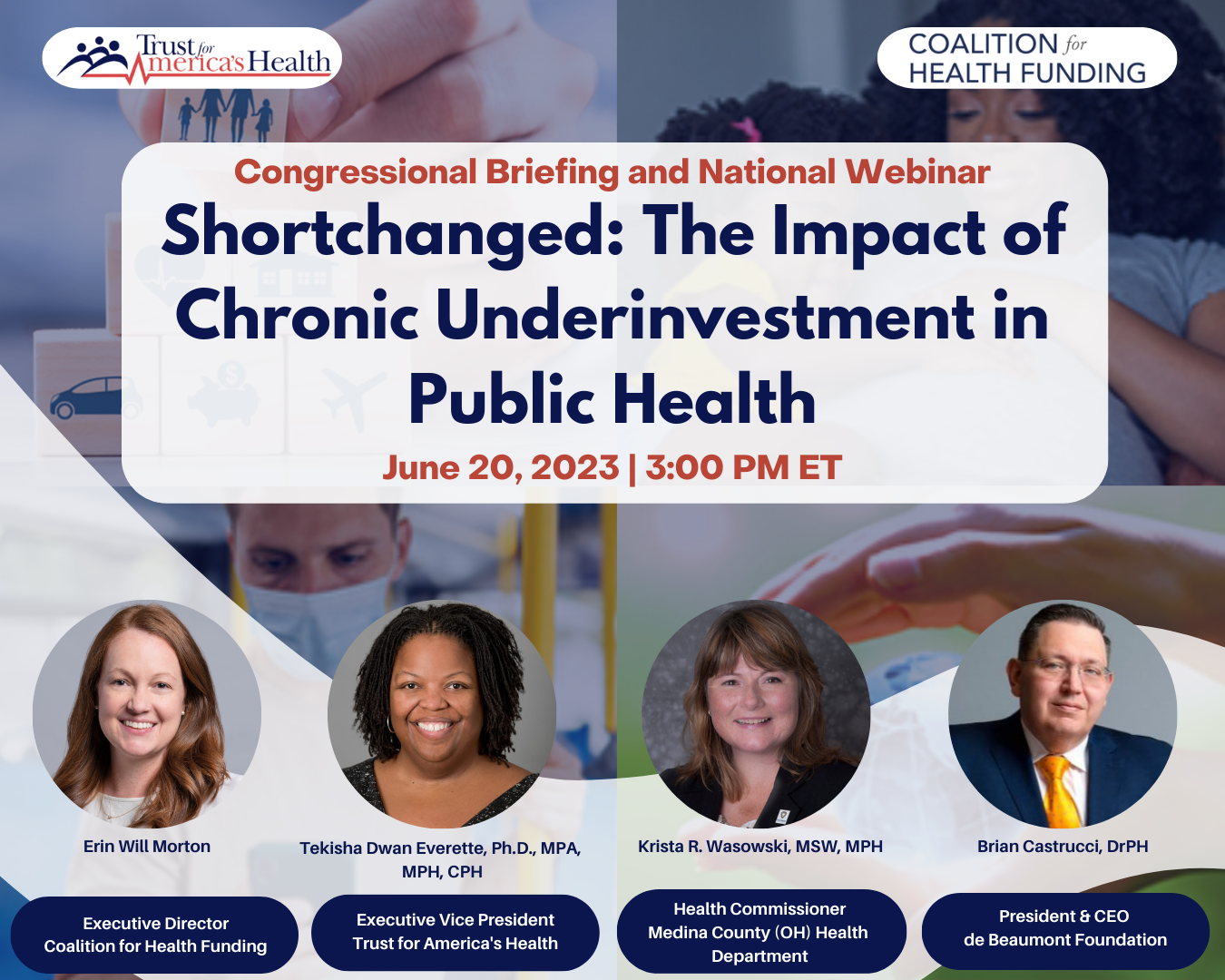
Shortchanged: The Impact of Chronic Underinvestment in Public Health

Policymakers are asking: With the United States spending far more on healthcare compared to other high-income nations, why does our nation still yield substantially worse health outcomes and what funding and policy actions must we take to see better results?

To shed light on that important question, Trust for America’s Health (TFAH) and the Coalition for Health Funding (CHF) are gathering experts in public health policy and funding on June 20th to discuss the critical need for increased, sustainable, and flexible funding that specifically targets public health and prevention. The discussion will focus on how to address the longstanding gaps in public health capacity resulting from chronic underfunding.

Resources:

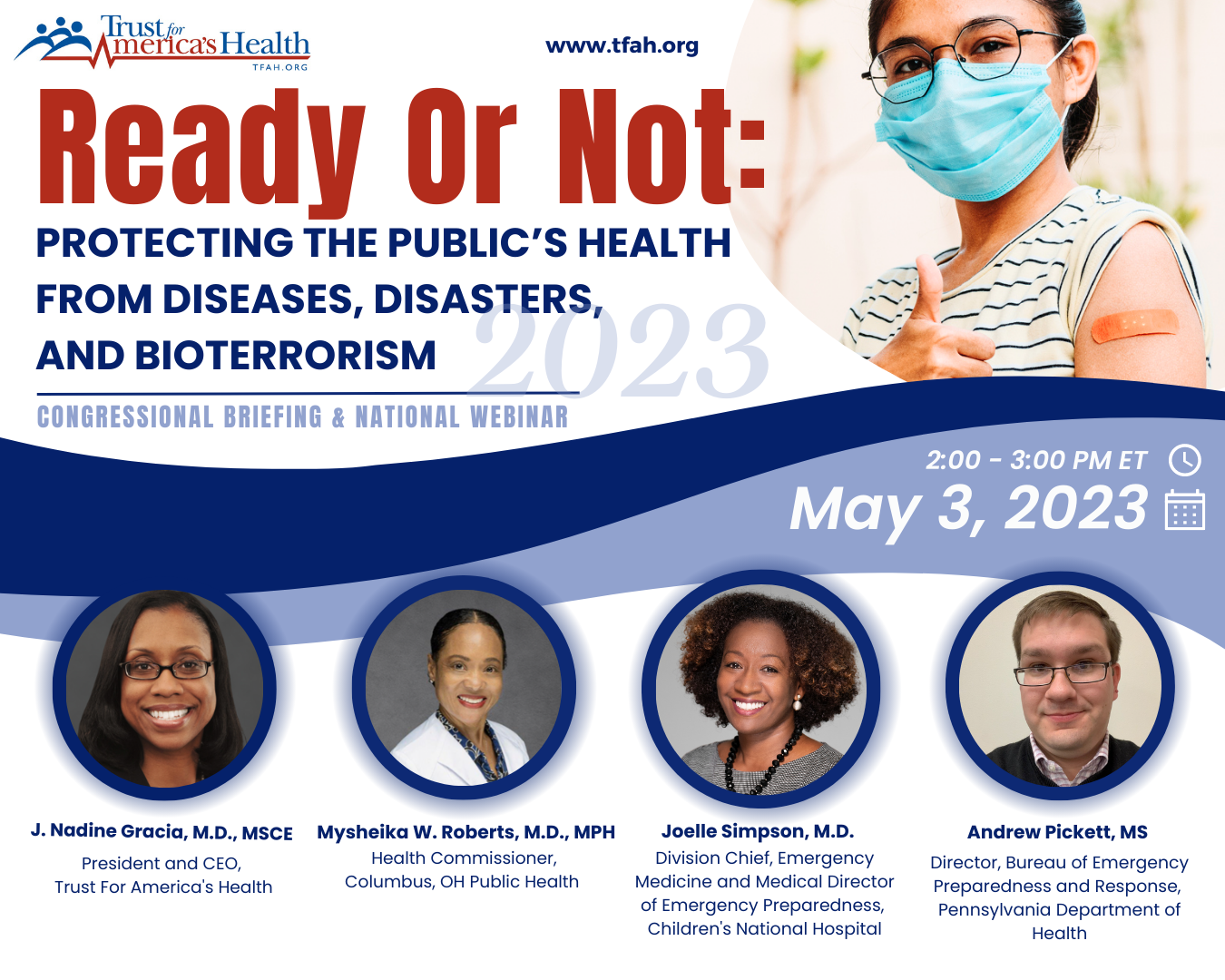
Ready or Not 2023: Protecting the Public’s Health from Diseases, Disasters, and Bioterrorism

This briefing explores the findings from TFAH’s recent report, Ready or Not 2023: Protecting the Public’s Health from Diseases, Disasters, and Bioterrorism.

The past year alone saw the U.S. surpassing 1 million deaths due to COVID-19, decreasing rates of routine vaccinations, and increasing prevalence of health misinformation. In addition, last year the U.S. experienced 10 or more billion-dollar weather-related disasters for the eighth consecutive year. The webinar will review TFAH’s 2023 Ready or Not report which measures states’ degree of preparedness to respond to a wide spectrum of health emergencies and to provide ongoing public health services.

Subject matter experts discussed the nation’s readiness for public health emergencies, examine the findings of the report, and discuss key recommendations for policymakers.

Resources:

Trust for America’s Health

Children’s National Hospital

Nuevo informe mide la preparación para emergencias de los estados y hace recomendaciones sobre cómo fortalecer el sistema de salud pública de la nación

Se necesita una inversión sostenida en infraestructura de salud pública y preparación para proteger vidas durante brotes de enfermedades y desastres naturales

(Washington, DC – 23 de marzo de 2023) – A medida que los brotes de enfermedades infecciosas y los fenómenos meteorológicos extremos amenazan la salud de más estadounidenses, un nuevo informe muestra la necesidad de fortalecer la preparación para emergencias de salud pública a nivel nacional y estatal.

Ready or Not 2023: Protecting the Public’s Health from Diseases, Disasters, and Bioterrorism, informe publicado hoy por Trust for America’s Health, mide la preparación de los estados para responder a un espectro de emergencias de salud y brindar servicios de salud pública continuos. El informe brinda a los funcionarios de salud federales y estatales y a los formuladores de políticas datos procesables y recomienda políticas para mejorar la preparación para emergencias de la nación en un momento en que las emergencias de salud están aumentando. Durante el 2022, los Estados Unidos superó el millón de muertes debido al COVID-19 y experimentó tasas decrecientes de vacunas de rutina y una prevalencia creciente de información errónea sobre la salud. Además, el año pasado fue el octavo año consecutivo en que los Estados Unidos experimentó 10 o más desastres relacionados con el clima con un impacto de mil millones de dólares.

El informe clasifica a los estados y al Distrito de Columbia en tres niveles de desempeño para la preparación para emergencias de salud: alto, medio y bajo. El informe de este año colocó a 19 estados y DC en el nivel de alto rendimiento, 16 estados en el nivel de rendimiento medio y 15 estados en el nivel de bajo rendimiento.

Nivel alto: 19 estados y DC

CO, CT, DC, DE, FL, GA, KS, ME, MD, MA, MS, NJ, NC, OH, PA, UT, VT, VA, WA, WI

Nivel medio: 16 estados

Alaska, Alabama, AR, CA, IA, ID, IL, IN, MO, ND, NE, NH, NY, RI, SC, TX

Nivel bajo: 15 estados

AZ, HI, KY, LA, MI, MN, MT, NM, NV, OK, OR, SD, TN, WV, WY

“Una inversión mayor y sostenida en infraestructura de salud pública, preparación para emergencias y equidad en salud salvará vidas”, dijo J. Nadine Gracia, M.D., MSCE, presidenta y directora ejecutiva de Trust for America’s Health. “Los funcionarios federales, estatales y locales, así como los líderes de los sectores empresarial y de atención de la salud deben utilizar nuestros hallazgos para identificar y abordar las brechas en la preparación de la salud pública. No hacerlo significará que el país no estará tan preparado como debe estar para la próxima emergencia de salud pública”.

Las áreas de fuerte desempeño incluyen:

  • La mayoría de los estados han hecho preparativos para expandir la capacidad de los laboratorios de atención médica y salud pública en una emergencia.
  • La mayoría de los estados están acreditados en las áreas de salud pública o manejo de emergencias. Algunos estados están acreditados en ambos.
  • La mayoría de los residentes de EE. UU. que recibieron el agua de su hogar a través de un sistema de agua comunitario tenían acceso a agua segura. Sin embargo, las fallas recientes en el sistema de agua en Jackson, Mississippi y Newark, Nueva Jersey demuestran la importancia de prestar atención continua a la integridad de los sistemas de agua municipales.

Las áreas que necesitan atención incluyen:

  • Muy pocas personas se vacunaron contra la gripe estacional el año pasado a pesar de la mejora significativa en las tasas de vacunación contra la gripe en los últimos años. Durante la temporada de influenza 2021-2022, el 51 % de los estadounidenses de 6 meses o más recibieron una vacuna contra la influenza, muy por debajo de la meta del 70 % establecida por Healthy People 2030.
  • Solo la mitad de la población de los Estados Unidos cuenta con un sistema integral de salud pública. Los sistemas integrales de salud pública aseguran que los servicios de salud necesarios estén disponibles para todos los residentes.
  • Solo el 26 por ciento de los hospitales en los estados, en promedio, obtuvo una calificación de seguridad del paciente de máxima calidad en el 2022. Las puntuaciones de seguridad hospitalaria miden el desempeño en temas tales como las tasas de infecciones asociadas con la atención médica, la capacidad de cuidados intensivos y una cultura general de prevención de errores.

El informe contiene recomendaciones para acciones políticas que crearían un sistema de salud pública más sólido en todos los niveles, que incluyen:

  • La Administración, el Congreso y los legisladores estatales deben modernizar la infraestructura de salud pública, incluso mediante la inversión de $4500 millones anuales para respaldar las capacidades básicas de salud pública. Además, el Congreso debe continuar aumentando los fondos para el acuerdo cooperativo de preparación para emergencias de salud pública y la modernización de datos de salud pública para permitir una detección más temprana y precisa de amenazas emergentes para la salud.
  • Los formuladores de políticas en todos los niveles deben actuar para proteger y fortalecer a las autoridades de salud pública y deben priorizar la recuperación de la confianza en las agencias y líderes de salud pública.
  • El Congreso y las legislaturas estatales deben invertir en comunicaciones efectivas de salud pública, incluida la lucha contra la desinformación.
  • El Congreso y los estados deben garantizar la cobertura del primer dólar para todas las vacunas recomendadas bajo seguros comerciales y para personas sin seguro. Los estados deben minimizar las exenciones de vacunas para niños en edad escolar, y los centros de atención médica deben aumentar las tasas de vacunación para los trabajadores de la salud.
  • El Congreso y los estados deben otorgar licencias remuneradas con protección laboral a los empleados debido a enfermedades o demandas de cuidado familiar.
  • El Congreso y los estados deben invertir en políticas y capacidad para abordar los determinantes sociales de la salud, como vivienda segura, acceso al transporte y acceso a alimentos saludables.
  • El Congreso debe financiar toda la empresa de contramedidas médicas (MCM), incluida la distribución y dispensación de MCM. El Congreso también debería crear incentivos para nuevos productos para prevenir y combatir las infecciones resistentes a los antibióticos.
  • El Congreso y los estados deben fortalecer la preparación para el cambio climático, el clima extremo y las amenazas a la salud ambiental.


Lea el informe completo en:  Ready or Not 2023


Trust for America’s Health es una organización no partidista y sin fines de lucro que promueve la salud óptima para cada persona y comunidad y hace de la prevención de enfermedades y lesiones una prioridad nacional.