Issue Category: Substance Misuse and Mental Health
Pain in the Nation 2022: Congressional Briefing and Webinar
Deaths associated with alcohol, drugs, and suicide took the lives of 186,763 Americans in 2020, a 20 percent one year increase in the combined death rate and the highest number of substance misuse deaths ever recorded for a single year. These data are part of a report releasing today, Pain in the Nation: The Epidemics of Alcohol, Drug, and Suicide Deaths, the latest in a series of reports tracking the nation’s deaths of despair crisis produced by Trust of America’s Health and Well Being Trust.
No single program or policy will be a cure-all to address these issues. Instead, a comprehensive approach that focuses on the underlying causes of these deaths of despair can help heal individuals and communities and make them more resilient.
Resources:
Trust for America’s Health
- Pain in the Nation 2022 Policy Fact Sheet
- Pain in the Nation: The Epidemics of Alcohol, Drug, and Suicide Deaths
Well Being Trust
- A Nation in Pain,written by Dr. J. Nadine Gracia and Benjamin F. Miller
- A Small Light in a Vast Darkness, written by Benjamin F. Miller
- Evokate
- StrengthinUs
Pain in the Nation 2022: U.S. Experienced Highest Ever Combined Rates of Deaths Due to Alcohol, Drugs, and Suicide During the First Year of the COVID-19 Pandemic
Estados Unidos experimentó las tasas combinadas más altas de muertes debido al alcohol, las drogas y el suicidio durante la pandemia de COVID-19
Las muertes abarcaron edades, grupos raciales y étnicos y geografía, pero dañaron de manera desproporcionada a ciertos jóvenes y personas de color.
Las soluciones son conocidas y deben implementarse
(Washington, DC – 24 de mayo de 2022) – Las muertes asociadas con el alcohol, las drogas y el suicidio cobraron la vida de 186.763 estadounidenses en el 2020, un aumento del 20 % en un año en la tasa de mortalidad combinada y la mayor cantidad de muertes por uso indebido de sustancias jamás registrada durante un solo año, según un informe publicado hoy por Trust for America’s Health (TFAH) y Well Being Trust.
Además, los datos provisionales de los Centros para el Control y la Prevención de Enfermedades muestran que las muertes por sobredosis de drogas continuaron aumentando en el 2021.
Si bien las muertes por alcohol, drogas y suicidio han aumentado durante décadas, el aumento durante el 2020 no tuvo precedentes y fue impulsado por un aumento del 30 % en la tasa de muertes inducidas por drogas y un aumento del 27 % en la tasa de muertes inducidas por el alcohol. Las tasas combinadas de muertes por alcohol, drogas y suicidio aumentaron en los 50 estados excepto New Hampshire, y por primera vez dos estados (Virginia Occidental y Nuevo México) superaron las 100 muertes por cada 100,000 residentes estatales por alcohol, drogas y suicidio combinados en un solo año
o La tasa general de muertes inducidas por drogas aumentó en un 30 por ciento, en gran parte impulsada por aumentos en las muertes debido al uso de opioides sintéticos y psicoestimulantes. La tasa de muerte inducida por drogas aumentó para todos los grupos de población menos uno: los mayores de 75 años. Hubo aumentos particularmente grandes en las comunidades de color, entre los jóvenes (de 17 años o menos) y los adultos jóvenes (de 18 a 34 años) y en las regiones sur y oeste del país.
o Las tasas de mortalidad inducida por el alcohol aumentaron en un 27 por ciento, y el aumento abarcó grupos demográficos y partes del país, incluidos los 50 estados y el Distrito de Columbia. Los aumentos fueron particularmente altos entre los adultos jóvenes, los indios americanos/nativos de Alaska y las comunidades asiáticas, y entre los que viven en el Medio Oeste.
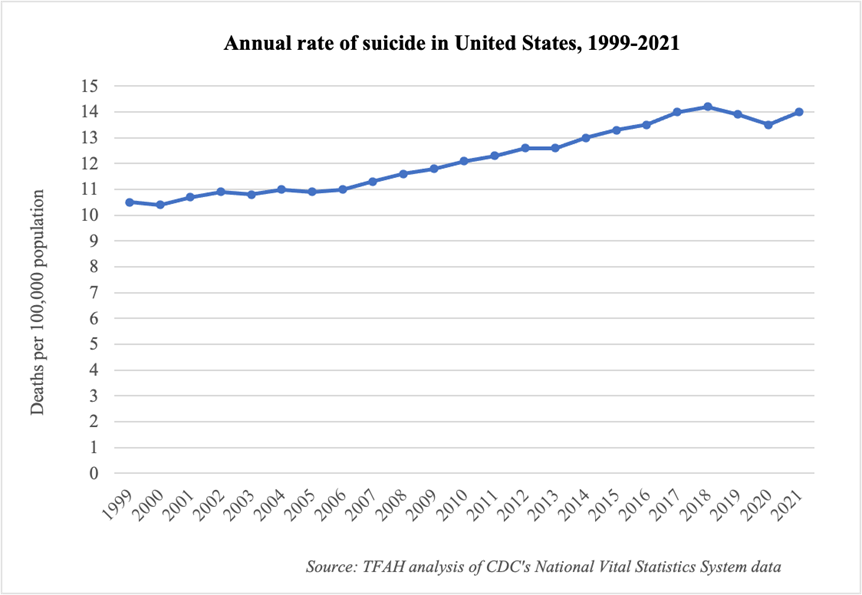
o Las tasas generales de suicidio disminuyeron en un 3 por ciento, pero esa tendencia no fue universal. La disminución se produjo entre los blancos, pero las muertes por suicidio durante el año aumentaron entre los indios americanos, los negros y los latinos. Las tasas de suicidio de adultos de 35 a 74 años de edad disminuyeron, pero las tasas de jóvenes y adultos jóvenes aumentaron.
“Con las tendencias que continúan yendo en la dirección equivocada, debemos preguntarnos, ¿qué se necesita para pasar a una acción sólida e integral? La historia detrás de estos datos es más que devastadora y desgarradora para aquellas familias que han sufrido pérdidas”, dijo el Dr. Benjamin F. Miller, presidente de Well Being Trust. “Empecemos a atender esta crisis con la urgencia que se merece llevando atención donde está la gente. Desde las escuelas hasta la atención primaria y nuestros lugares de trabajo, asegurémonos de que todos los lugares estén equipados para abordar la salud mental y el abuso de sustancias. Esta no es solo la responsabilidad del campo de la salud mental y las adicciones, sino toda nuestra responsabilidad”.
TFAH y Well Being Trust han estado informando muertes inducidas por alcohol, drogas y suicidio como parte de su iniciativa Pain in the Nation desde 2018. En el informe inaugural de la iniciativa de 2018, las muertes por alcohol, drogas y suicidio representaron 55,403 muertes por año, en comparación con las 186.763 muertes asociadas con el alcohol, las drogas o el suicidio en el informe de este año. Según los autores del informe y otros expertos, el sorprendente aumento de las muertes por alcohol y drogas en el 2020 se vio exacerbado por: un aumento continuo de las sobredosis de opioides sintéticos y psicoestimulantes y la ansiedad, el estrés, el dolor, la interrupción de los programas de recuperación del abuso de sustancias y las dificultades financieras muchas personas y familias experimentaron durante la pandemia de COVID-19.
El informe incluye recomendaciones sobre los pasos que los gobiernos federal, estatal y local deben tomar para comenzar a revertir la crisis de las muertes por desesperación. Incluyen:
Invertir en programas que promuevan la salud y prevengan el uso indebido de sustancias y el suicidio:
- Apoyar programas en la escuela enfocados en la salud mental de los estudiantes y la prevención del uso de sustancias.
- Fortalecer los programas informados sobre el trauma y culturalmente competentes y lingüísticamente apropiados dentro de todas las agencias que atienden a los jóvenes, incluido el sistema de justicia juvenil.
- Fortalecer la continuidad de los programas de intervención en crisis con un enfoque en la línea de vida “988” recientemente establecida.
- Expandir los esfuerzos integrales de prevención del suicidio de los CDC, incluidas medidas para fortalecer los apoyos económicos, promover la conexión y crear entornos protectores.
- Desarrollar programas que aborden los determinantes sociales de la salud y promuevan la resiliencia en los niños, las familias y las comunidades, incluidos aquellos enfocados en la prevención de experiencias infantiles adversas.
Abordar las crisis de uso indebido y sobredosis de sustancias:
- Promover políticas de reducción de daños para reducir las sobredosis y las infecciones transmitidas por la sangre, incluido el aumento del acceso a programas de servicio de jeringas, naloxona y tiras reactivas de fentanilo.
- Preservar y ampliar los programas que crean un acceso más flexible al tratamiento del trastorno por consumo de sustancias durante la pandemia.
- Financiamiento directo del acuerdo de litigio de opioides para la prevención primaria del abuso de sustancias por parte de los jóvenes.
- Reducir el consumo excesivo de alcohol mediante políticas que limiten dónde y cuándo se puede servir/comprar alcohol y mediante el uso de impuestos especiales sobre el alcohol.
Transformar el sistema de prevención de salud mental y abuso de sustancias
- Aumentar el acceso al tratamiento de salud mental y uso de sustancias a través de la plena aplicación de la Ley de Equidad en Adicción y Paridad en Salud Mental.
- Combatir el estigma sobre los problemas de salud mental y el acceso al servicio.
- Modernizar los servicios de salud física y mental alineando la prestación de servicios, el pago de los proveedores, las medidas de calidad y la capacitación hacia la salud integral de las personas y la atención integrada.
- Desarrollar la capacidad comunitaria de base para la identificación e intervención tempranas de personas con trastornos de salud mental y uso de sustancias, incluso a través de entornos comunitarios o no tradicionales.
“Es imperativo que los funcionarios de todos los niveles del gobierno actúen sobre las políticas recomendadas en este informe. Los datos son sorprendentemente claros: las vidas corren peligro en todas las comunidades debido al alcohol, las drogas y el suicidio, y las comunidades que experimentan desventajas debido a las desigualdades sociales, económicas y ambientales de larga data sufren un impacto desproporcionado. Existe una necesidad urgente de actuar para salvar vidas”, dijo J. Nadine Gracia, presidenta y directora ejecutiva de Trust for America’s Health.
Lea el informe completo
# # #
Trust for America’s Health es una organización no partidista y sin fines de lucro que promueve la salud óptima para cada persona y comunidad y hace de la prevención de enfermedades y lesiones una prioridad nacional.
Well Being Trust es una filantropía de impacto dedicada a promover la salud mental, social y espiritual de la nación.
U.S. Drug Overdose Deaths Increased by 31 Percent in 2020; Up 56 Percent for Synthetic Opioids
(Washington, DC – January 4, 2022) According to a National Center for Health Statistics report released the last week of 2021 using official annual mortality data, 91,799 Americans died from drug overdoses in 2020. This is an astounding 31 percent increase over the 2019 rate and the largest year-over-year rate increase on record. Additional data suggests that 2021 drug overdose deaths continued to increase, underscoring the negative impact the COVID-19 pandemic has had on the health and well-being of Americans.
The increases in drug deaths occurred nationally, spanning age, sex, and racial/ethnic groups. In both 2019 and 2020, the highest overdose deaths rates were for American Indian/Alaska Native people and the largest percentage increase in drug overdose death rates from 2019 to 2020 were seen in Black and Native Hawaiian/Other Pacific Islander people. These data show again the urgent need for comprehensive action to address the nation’s growing substance misuse crisis among diverse populations.
Additional analysis by Trust for America’s Health (TFAH) and Well Being Trust (WBT) of state-level data show nearly all states and the District of Columbia saw increases between 2019 and 2020, including very large ones for many states.
- Five states—Kentucky, Louisiana, Mississippi, South Carolina, and West Virginia—had drug overdose death rates that increased by more than 50 percent between 2019 and 2020.
- Just seven states had increases under 10 percent, including three states (Delaware, New Hampshire, and South Dakota) that saw declines.
“The long-term and recent trends in drug overdoses are alarming, and require more attention from policymakers,” said J. Nadine Gracia, M.D., MSCE, President and CEO of Trust for America’s Health. “As we continue to respond to and work to recover from the pandemic, we must take a comprehensive approach that includes policies and programs that reduce overdoses and help Americans suffering from addiction. Policies that address social, economic, and environmental disadvantage, such as childhood trauma, poverty, and discrimination, are needed to help change the trajectory of alcohol, drug, and suicide deaths in the coming decades.”
Over the last five years, TFAH and WBT have released as series of reports on “deaths of despair” called Pain in the Nation: The Drug, Alcohol and Suicides Epidemics and the Need for a National Resilience Strategy, which include data analysis and recommendations for evidence-based policies and programs that federal, state, and local officials. The 2022 Pain in the Nation report will be released in May.
“This comes down to leadership and action. If we don’t move to do something now, these terrible trends will only continue,” said Benjamin F. Miller, PsyD, President of Well Being Trust. “The data are clear— we need to move beyond talk and push for programs and policies that work; and, we need to do so in a way that recognizes that all communities are different and each are going to benefit from a more tailored approach to address this massive problem.”
Key findings by drug-type from the recent NCHS report include:
- Overall drug overdoses deaths: 91,799 Americans died from drug overdoses in 2020, a rate of 28.3 deaths per 100,000 people. This is a rate 31 percent higher than over 2019 when 70,630 Americans died of drug overdoses (21.6 deaths per 100,000).
- Opioid overdose deaths: 68,630 Americans died from opioid overdoses in 2020, a rate of 21.4 deaths per 100,000 people. This is a rate 38 percent higher than 2019 when 49,860 Americans died of opioid overdoses (15.5 deaths per 100,000).
- Synthetic opioid overdose deaths: 56,516 Americans died from synthetic opioid overdoses in 2020, a rate of 17.8 deaths per 100,000 people. That is a rate 56 percent higher than 2019, when 36,359 Americans died of synthetic opioids overdoses (11.4 deaths per 100,000). The rate of synthetic opioid overdose deaths has increased more than fivefold over the past five years.
- Cocaine overdose deaths: 19,447 Americans died from cocaine overdoses in 2020, a rate of 6.0 deaths per 100,000 people. That rate is 22 percent higher than 2019, when 15,883 Americans died of cocaine overdoses (4.9 deaths per 100,000). The rate of cocaine overdose deaths has increased by almost threefold over the past five years.
- Psychostimulant overdose deaths: 23,837 Americans died from psychostimulants in 2020, a rate of 7.5 deaths per 100,000 people. That’s a rate 50 percent higher than 2019, when 16,167 Americans died from psychostimulant overdoses (5.0 deaths per 100,000). The rate of psychostimulants overdose death has increased by fourfold over the past five years.
Additional annual, racial/ethnic, and state-level data can be found below.
Drug Overdose Deaths, 1999-2020
| Year | Deaths | Deaths per 100,000 (Age Adjusted) |
| 1999 | 16,849 | 6.1 |
| 2000 | 17,415 | 6.2 |
| 2001 | 19,394 | 6.8 |
| 2002 | 23,518 | 8.2 |
| 2003 | 25,785 | 8.9 |
| 2004 | 27,424 | 9.4 |
| 2005 | 29,813 | 10.1 |
| 2006 | 34,425 | 11.5 |
| 2007 | 36,010 | 11.9 |
| 2008 | 36,450 | 11.9 |
| 2009 | 37,004 | 11.9 |
| 2010 | 38,329 | 12.3 |
| 2011 | 41,340 | 13.2 |
| 2012 | 41,502 | 13.1 |
| 2013 | 43,982 | 13.8 |
| 2014 | 47,055 | 14.7 |
| 2015 | 52,404 | 16.3 |
| 2016 | 63,632 | 19.8 |
| 2017 | 70,237 | 21.7 |
| 2018 | 67,367 | 20.7 |
| 2019 | 70,630 | 21.6 |
| 2020 | 91,799 | 28.3 |
Source: National Vital Statistics System, National Center for Health Statistics
Drug Overdose Deaths by Racial/Ethnic Groups, 2019-2020
| Racial/Ethnic Group | 2019 Deaths | 2019 Deaths Per 100,000 (Age Adjusted) | 2020 Deaths | 2020 Deaths Per 100,000 (Age Adjusted) | Change in Death Rate, 2019–2020 |
| Non-Hispanic White | 50,044 | 26.2 | 62,312 | 33.1 | 26% |
| Non-Hispanic Black | 10,517 | 24.8 | 15,256 | 35.8 | 44% |
| Non-Hispanic American Indian/ Alaska Native | 723 | 30.5 | 1,009 | 42.5 | 39% |
| Non-Hispanic Asian | 679 | 3.3 | 935 | 4.6 | 39% |
| Non-Hispanic Native Hawaiian/ Other Pacific Islander | 58 | 9.5 | 86 | 13.7 | 44% |
| Hispanic | 7,473 | 12.7 | 10,606 | 17.6 | 39% |
Source: National Vital Statistics System, National Center for Health Statistics
Drug Overdose Deaths by State, 2019-2020
| State | 2019 Deaths | 2019 Deaths Per 100,000 (Age Adjusted) | 2020 Deaths | 2020 Deaths Per 100,000 (Age Adjusted) | Change in Death Rate, 2019–2020 |
| Alabama | 768 | 16.3 | 1029 | 22.3 | 37% |
| Alaska | 132 | 17.8 | 160 | 22.0 | 24% |
| Arizona | 1907 | 26.8 | 2550 | 35.8 | 33% |
| Arkansas | 388 | 13.5 | 546 | 19.1 | 41% |
| California | 6198 | 15.0 | 8908 | 21.8 | 46% |
| Colorado | 1079 | 18.0 | 1492 | 24.9 | 38% |
| Connecticut | 1214 | 34.7 | 1371 | 39.1 | 13% |
| Delaware | 435 | 48.0 | 444 | 47.3 | -2% |
| D.C. | 311 | 43.2 | 424 | 58.1 | 34% |
| Florida | 5268 | 25.5 | 7231 | 35.0 | 37% |
| Georgia | 1408 | 13.1 | 1916 | 18.0 | 38% |
| Hawaii | 242 | 15.9 | 274 | 18.3 | 15% |
| Idaho | 265 | 15.1 | 287 | 15.9 | 5% |
| Illinois | 2790 | 21.9 | 3549 | 28.1 | 28% |
| Indiana | 1699 | 26.6 | 2321 | 36.7 | 38% |
| Iowa | 352 | 11.5 | 432 | 14.3 | 25% |
| Kansas | 403 | 14.3 | 490 | 17.4 | 22% |
| Kentucky | 1380 | 32.5 | 2083 | 49.2 | 51% |
| Louisiana | 1267 | 28.3 | 1896 | 42.7 | 51% |
| Maine | 371 | 29.9 | 496 | 39.7 | 33% |
| Maryland | 2369 | 38.2 | 2771 | 44.6 | 17% |
| Massachusetts | 2210 | 32.1 | 2302 | 33.9 | 6% |
| Michigan | 2385 | 24.4 | 2759 | 28.6 | 17% |
| Minnesota | 792 | 14.2 | 1050 | 19.0 | 34% |
| Mississippi | 394 | 13.6 | 586 | 21.1 | 55% |
| Missouri | 1583 | 26.9 | 1875 | 32.1 | 19% |
| Montana | 143 | 14.1 | 162 | 15.6 | 10% |
| Nebraska | 161 | 8.7 | 214 | 11.3 | 30% |
| Nevada | 647 | 20.1 | 832 | 26.0 | 29% |
| New Hampshire | 407 | 32.0 | 393 | 30.3 | -5% |
| New Jersey | 2805 | 31.7 | 2840 | 32.1 | 1% |
| New Mexico | 599 | 30.2 | 784 | 39.0 | 29% |
| New York | 3617 | 18.2 | 4965 | 25.4 | 39% |
| North Carolina | 2266 | 22.3 | 3146 | 30.9 | 39% |
| North Dakota | 82 | 11.4 | 114 | 15.6 | 37% |
| Ohio | 4251 | 38.3 | 5204 | 47.2 | 23% |
| Oklahoma | 645 | 16.7 | 762 | 19.4 | 17% |
| Oregon | 615 | 14.0 | 803 | 18.7 | 34% |
| Pennsylvania | 4377 | 35.6 | 5168 | 42.4 | 19% |
| Rhode Island | 307 | 29.5 | 397 | 38.2 | 29% |
| South Carolina | 1127 | 22.7 | 1739 | 34.9 | 54% |
| South Dakota | 86 | 10.5 | 83 | 10.3 | -2% |
| Tennessee | 2089 | 31.2 | 3034 | 45.6 | 46% |
| Texas | 3136 | 10.8 | 4172 | 14.1 | 31% |
| Utah | 571 | 18.9 | 622 | 20.5 | 8% |
| Vermont | 133 | 23.8 | 190 | 32.9 | 38% |
| Virginia | 1547 | 18.3 | 2240 | 26.6 | 45% |
| Washington | 1259 | 15.8 | 1733 | 22.0 | 39% |
| West Virginia | 870 | 52.8 | 1330 | 81.4 | 54% |
| Wisconsin | 1201 | 21.1 | 1531 | 27.7 | 31% |
| Wyoming | 79 | 14.1 | 99 | 17.4 | 23% |
Source: TFAH and WBT analysis of data from the National Center for Health Statistics
Trust for America’s Health is a nonprofit, nonpartisan organization that promotes optimal health for every person and community and makes the prevention of illness and injury a national priority. www.tfah.org Twitter:@HealthyAmerica1
Well Being Trust is a national foundation dedicated to advancing the mental, social, and spiritual health of the nation. Created to include participation from organizations across sectors and perspectives, Well Being Trust is committed to innovating and addressing the most critical mental health challenges facing America, and to transforming individual and community well-being. www.wellbeingtrust.org. Twitter: @WellBeingTrust
Trust for America’s Health and Well Being Trust Applaud the Surgeon General’s Advisory on Youth Mental Health
The challenges to our children’s mental health were many before COVID-19 and made worse by the pandemic – immediate action is needed
(December 7, 2021) – Trust for America’s Health and Well Being Trust strongly applaud U.S. Surgeon General Dr. Vivek Murthy’s Advisory on Youth Mental Health released today.
“We applaud the Surgeon General for not only drawing more attention to the issue of youth mental health, but reminding us that this problem, significant before COVID-19, has been negatively impacted during, and could only get worse after the pandemic without robust action,” said Benjamin F. Miller, PsyD, President of Well Being Trust. “By proactively addressing mental health, including bringing care to where people are, we are more likely to meet the moment in a way that can help countless young people and their families.”
The Surgeon General’s advisory calls for “a swift and coordinated response” to the nation’s youth mental health crisis and demonstrates the need for all sectors of society to be part of the solution with recommendations for what individuals, families, community organizations, technology companies and government can do to improve and protect young people’s mental health.
“One of the strengths of this advisory is that it recognizes that in order to support young people’s mental health we need to address the social and economic conditions in their lives with multisector initiatives, said J. Nadine Gracia, M.D., MSCE, President and CEO of Trust for America’s Health. “Where a child lives, where they go to school, their family’s access to employment and safe housing all impact their mental health.”
TFAH and WBT’s Pain in the Nation series has tracked the nation’s deaths of despair since 2017 including the escalating youth mental health crisis. Its report Addressing a Crisis: Cross-Sector Strategies to Prevent Adolescent Substance Use and Suicide. makes recommendations for cross sector action.
# # #
Trust for America’s Health is a nonprofit, nonpartisan organization that promotes optimal health for every person and community and makes the prevention of illness and injury a national priority. Twitter: @HealthyAmerica1
Well Being Trust is a national foundation dedicated to advancing the mental, social, and spiritual health of the nation. Created to include participation from organizations across sectors and perspectives, Well Being Trust is committed to innovating and addressing the most critical mental health challenges facing America, and to transforming individual and community well-being. www.wellbeingtrust.org. Twitter: @WellBeingTrust
Sign-on Letter in Support of Improving Data Collection for ACEs Act (June 2021)
CDC Adverse Childhood Experiences- FY22
Pain in the Nation: How High Rates of Suicide, Drugs and Overdose Deaths Require a Comprehensive Resiliency Strategy